As millions of people face heat advisories warning of dangerous temperatures across the South on Monday, frost advisories were issued in five states, serving as a reminder that the first hard freeze of the season could hit as soon as this month for some even as oppressive temperatures remain a reality for the foreseeable future for others. On Monday, heat advisories were in place for parts of Texas, Oklahoma, Kansas, Louisiana, Arkansas, Missouri, Illinois, Indiana, Kentucky, Tennessee, Alabama, and Mississippi as part of a summer-long trend that produced some of the warmest temperatures ever recorded in some cities across the country. While a temperature outlook through late September from the National Weather Service's (NWS) Climate Prediction Center anticipates that nearly all of the U.S. could experience above-average temperatures through the end of the month, a few NWS offices issued frost advisories for Tuesday, a stark reminder that chilly weather is not far off.
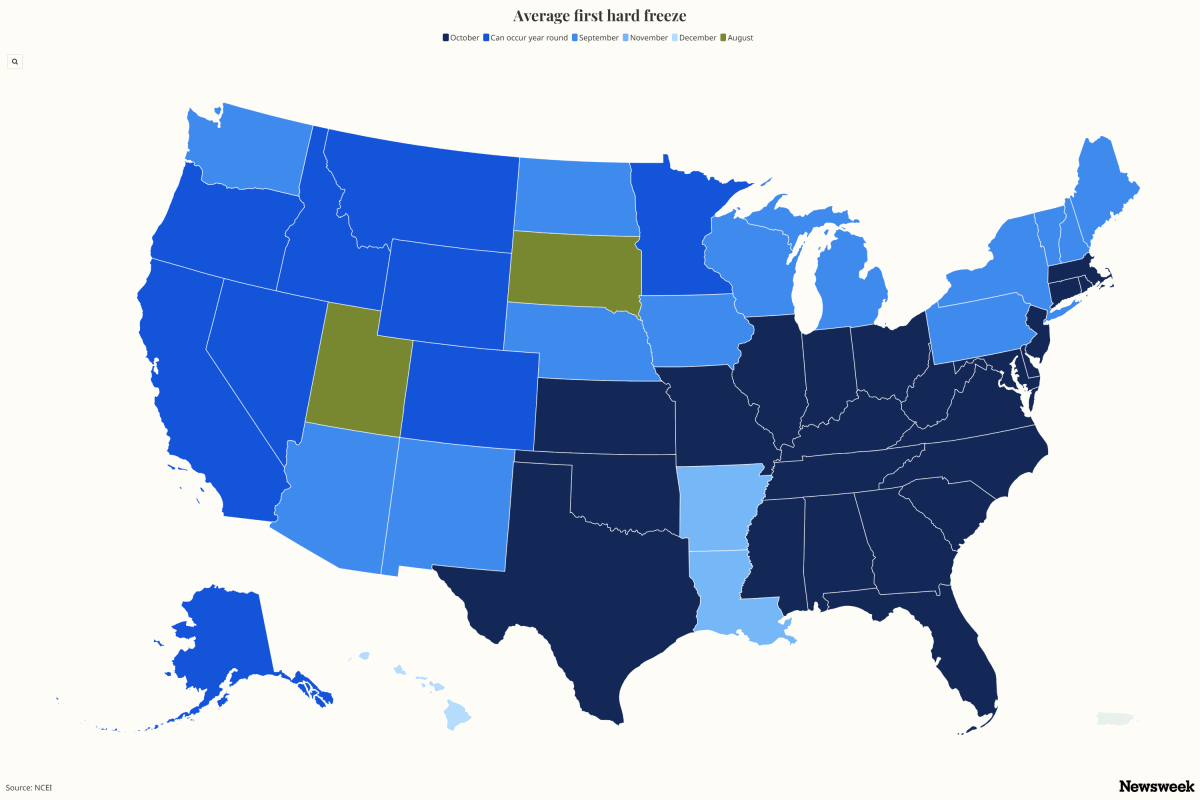
The NWS offices in Pocatello, Idaho; Gray, Maine, which was also forecasting for New Hampshire; and Burlington, Vermont, which was also forecasting for New York, issued the cold weather alerts, which are all set to go into effect early Tuesday morning as temperatures could dip into the low 30s. It was the first advisory of the season for each of the three offices, NWS meteorologists at each location told Newsweek, and in Maine, NWS meteorologist Cameron Barker told Newsweek that more frost advisories were expected to be issued in the coming weeks. When compared to historical data from the National Centers for Environmental Information (NCEI), the timing of the frigid temperatures is right on track when it comes to climate normals.
Average first freeze dates each year can occur as soon as August 31 or earlier in certain parts of the country. A map created by Newsweek shows which month every state typically sees its first hard freeze. Northern states are more likely to see earlier first freeze dates, although high elevation regions of southern states also have sooner averages.
In nearly every state, the first freeze dates can vary widely because of elevation. However, frost can form even before temperatures dip below freezing. Frost, which can damage sensitive vegetation and harm outdoor pets, can occur even when air temperatures remain above freezing.
This is because the temperature near the ground can be as much as 5 degrees cooler than the official air temperature because of radiational cooling, according to the NWS. There are several different alerts the NWS issues when it comes to cold temperatures. A frost advisory, which was in place for Idaho, New York, New Hampshire, Vermont, and Maine, is issued when air temperatures are expected to be between 33 and 36 degrees on cool, clear nights, which could result in frost forming.
The more severe freeze warning is issued "when significant, widespread freezing temperatures are expected," the NWS said on its webpage about alerts, watches and warning. Both frost advisories and freeze warnings are issued during seasons where such cold temperatures could cause harm to crops or plants. There also are winter weather advisories, winter storm warnings, and extreme cold warnings, among other alerts.
Extract — continue reading at the source.