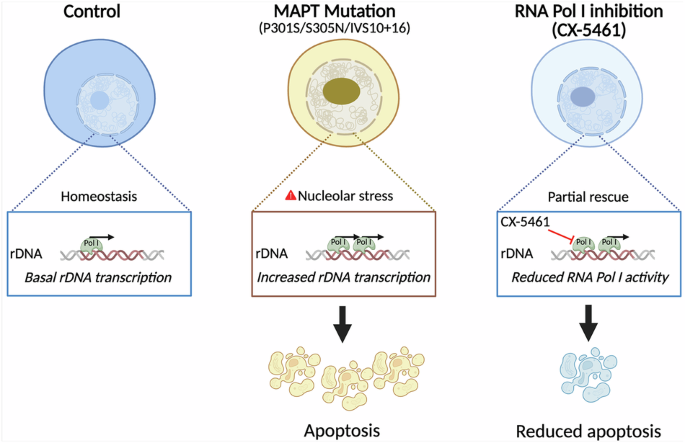
Tau is traditionally known for its role in microtubule stabilisation, with its pathological aggregation central to tauopathies such as Alzheimer’s disease (AD) and frontotemporal dementia (FTD). Recent evidence suggests that tau also plays important nuclear and nucleolar roles, yet the implications of tau pathology on nucleolar function remain poorly understood. Here, we show that tau localises to the nucleolus in both differentiated SH-SY5Y cells and human iPSC-neurons, and that disease-associated MAPT mutations are associated with increased nucleolar tau accumulation (P301S, S305N, and IVS 10 + 16).
Using high-content imaging, we found that mutant tau expression was associated with structural expansion of the nucleus and nucleolus, together with upregulation of key markers from all three nucleolar sub-compartments, consistent with increased nucleolar activity. qPCR and nucleolar RNA-selective dye staining demonstrated increased rDNA transcription and rRNA processing, consistent with enhanced nucleolar biosynthetic output in mutant tau-expressing cells. This increase in nucleolar activity was accompanied by markers of nucleolar stress and apoptosis, including p53 stabilisation, caspase 3/7 activation, and TUNEL positivity. Notably, pharmacological inhibition of RNA polymerase I in the inducible SH-SY5Y model attenuated caspase 3/7 activity, supporting a functional contribution of elevated rDNA transcriptional activity to downstream apoptotic signalling.
Together, these findings identify altered nucleolar homeostasis as a feature associated with mutant tau expression and support a potential contribution of nucleolar dysregulation to disease-associated cellular dysfunction in MAPT-linked FTD. We gratefully acknowledge the individuals and families who contributed biological samples used for the generation of the iPSC lines. This work was supported by funding to MBM from the Rainwater Charitable Foundation, the Alzheimer’s Association (AARFD-22-923450), the Wellcome Trust (224493/Z/21/Z), Alzheimer’s Research UK, and the Reviral Pump Prime Research Project Fund at the University of Sussex.
CMK is supported by the Rainwater Charitable Foundation, P30AG066444 and NS123985. CA and SW are supported by the National Institute for Health and Care Research University College London Hospitals Biomedical Research Centre. Sussex Neuroscience, School of Life Sciences, University of Sussex, BN1 9RH, Brighton, UK Zaid Muhammad, Yan Gu, Suleiman H.
Kwairanga, Amna Khan, Mohammad Nasser, Dana Aljarrah, Louise C. Maina Biomedical Science Research and Training Centre, Yobe State University, 620101, Damaturu, Nigeria Zaid Muhammad, Suleiman H. Maina Genome Damage and Stability Centre, School of Life Sciences, University of Sussex, Brighton, BN1 9RQ, UK Department of Biochemistry, School of Life Sciences, University of Sussex, Brighton, BN1 9QG, UK Department of Neurodegenerative Disease, UCL Queen Square Institute of Neurology, WC1N, London, UK Department of Psychiatry, Washington University in St.
Louis, 63110, Missouri, USA Faculty of Medical and Health Science, Newgate University Minna, Minna, 910104, Nigeria All authors declare no competing financial or non-financial interests in relation to the work described in this manuscript. This study used previously established human iPSC lines obtained from collaborating institutions. No new human participants were recruited, and no new human biological samples were collected specifically for this study.
Extract — continue reading at the source.