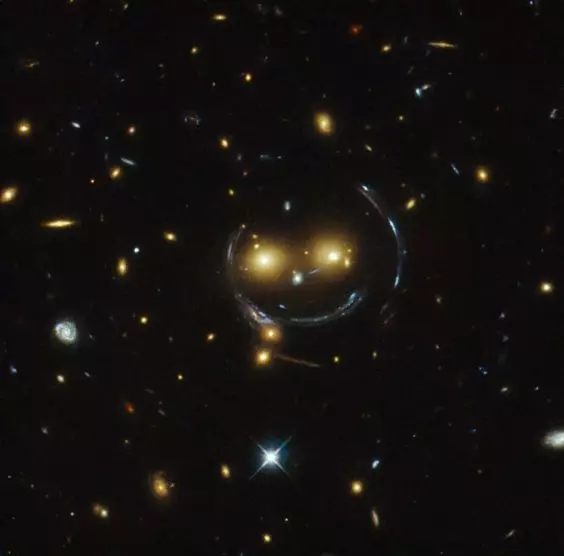
Nature has blessed us with brains that are hardwired to find patterns and recognize faces, so it’s no surprise we tend to notice faces even where there aren’t any. Although they may be better educated, the humans at NASA are no different than the rest of us. They recently posted an image of a smiley face discovered amongst the stars.
The photo, originally captured by the Hubble Space Telescope in 2015, shows a galaxy cluster known as SDSS J1038+4849 located 4.5 billion light-years from Earth in the Big Dipper constellation. In the photo, the two yellow “eyes” are actually massive galaxies. The face and smile, on the other hand, are caused by a phenomenon predicted by Einstein’s general theory of relativity: gravitational lensing.
Read more: “A Look Back at Hubble’s Most Breathtaking Images” A sufficiently massive celestial object is capable of distorting spacetime around it, so light that would ordinarily travel in a straight line (or be blocked by it) is instead bent around it. Astronomers and astrophysicists use gravitational lensing to determine the mass of galaxies, locate exoplanets, and even in the search for dark matter. The smiley face photo features a special case of gravitational lensing called an Einstein ring.
When the light source, the gravitational lens, and the observer (in this case Hubble) are all aligned, it produces a ring effect. But to those of us on Earth with socially evolved, pattern-seeking brains, it looks like it’s smiling. Subscribe to our free newsletter.
Extract — continue reading at the source.