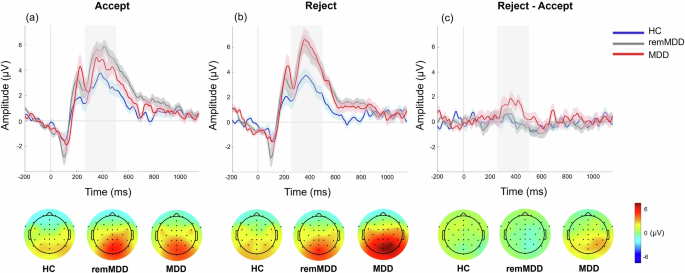
Understanding the role of peer feedback, particularly rejection, is critical for adolescent major depressive disorder (MDD). However, the neurophysiological markers core to peer feedback, especially those that may presage risk for depression, are unclear. Adolescents (N = 179; ages 13–18; healthy controls n = 62, remitted MDD n = 80, current MDD n = 37) completed a baseline clinical assessment and a revised Chatroom Task during EEG recording, from which the P3 to peer acceptance and rejection feedback was quantified.
Over 12 months, daily mood and keyboard inputs from adolescents’ smartphones were passively obtained. Linear models evaluated whether the P3 difference between rejection and acceptance (ΔP3) prospectively predicted depressive severity and average daily mood. Exploratory natural language processing examined whether friendship-focused social communication moderated the association between neural sensitivity to peer feedback and subsequent clinical outcomes.
Group and feedback type interacted in predicting P3 amplitude (F(2176) = 4.84, p = 0.009): adolescents with current MDD showed larger P3 amplitudes to rejection than acceptance, whereas remitted MDD showed elevated amplitudes to both feedback types relative to controls. In a general linear model adjusting for age, sex, site, and baseline depression severity, the Group × ΔP3 interaction was significant in predicting severity at follow-up (b = 0.092, p = 0.045); higher ΔP3 predicted higher follow-up severity in current MDD, but not in remitted MDD or healthy controls. Across the full sample, larger ΔP3 was associated with lower average daily mood over 12 months (b = −1.673, p = 0.045).
These findings suggest that enhanced neural sensitivity to peer rejection may be deeply engrained in adolescent depression, shaping both the longitudinal course of depressive symptoms and daily mood. Being rejected by peers is especially painful for teens with depression. We measured brain responses to peer acceptance and rejection in 179 adolescents, then tracked their mood through their smartphones for a year.
Teens with current depression showed stronger brain responses to rejection than acceptance. Larger rejection responses predicted worsening depressive symptoms in these teens, and lower daily mood across all participants. Heightened brain sensitivity to rejection may identify adolescents at risk and guide treatment.
Major depressive disorder (MDD) is one of the most prevalent psychiatric conditions in adolescence [1]. During this developmental period, social orientation shifts toward peers, with friendships and broader peer networks becoming increasingly central to identity, belonging, and social standing [2, 3]. This reorganization of social priorities unfolds in parallel with a marked increase in depression risk [1, 4, 5].
Extract — continue reading at the source.