The indie publisher Inpatient Press is doing fascinating, form-breaking work. The small publisher has been putting out fascinating novels, collections, zines and games since 2013. Inpatient’s publisher, Mitch Anzuoni, studied computer science and creative writing in college (fittingly) and aims “to publish what others do not.” Anzuoni told MIT Press, which distributes Inpatient’s book, that “the most important, and perhaps defining, characteristic of my publishing is the treatment of the book as a substantial object on its own, not some ready-made crucible for text and image to be poured into.” This deep interrogation has led to cool experiments in form and distribution, like a series of zines sold via newspaper vending machine.
These newsbox offerings (available as a set) included things like Armageddon News, a collection of leaflets and zines created by the FBI to target student activists, alongside their internal communications about this muckraking operation. An interest in the conditions of publication, and its weird slippages and exceptions, runs through everything Inpatient does. (This isn’t to say they’re not doing “regular” books too—Inpatient has published work by Samuel R. Delaney and Copi, as well as archival projects like a complete reprint of the legendary SF punk zine Search & Destroy.) Inpatient has also put out games geared more towards a fiction fan than a traditional gamer.
Their first and most straightforward game was “Small Press Tycoon”, which is billed as “the original DIY publishing adventure sim.” The game puts you in charge of a small publisher chasing metrics like “hipness” and “quality” as you “print chapbooks and zines, hold readings, discover new and exciting authors, sign distribution deals, and even win industry awards!” It’s all very meta and tongue-in-cheek, blending humor, critique, and surrealism. This was followed by “Mezzanine,” where you play as an HR administrator at the faux Y2K era multimedia start-up Zentropy. The game’s design is ripped straight from turn-of-the-millennium graphics: Zentropy’s offices are rendered smooth and shiny, approaching a bloated chrome uncanniness.
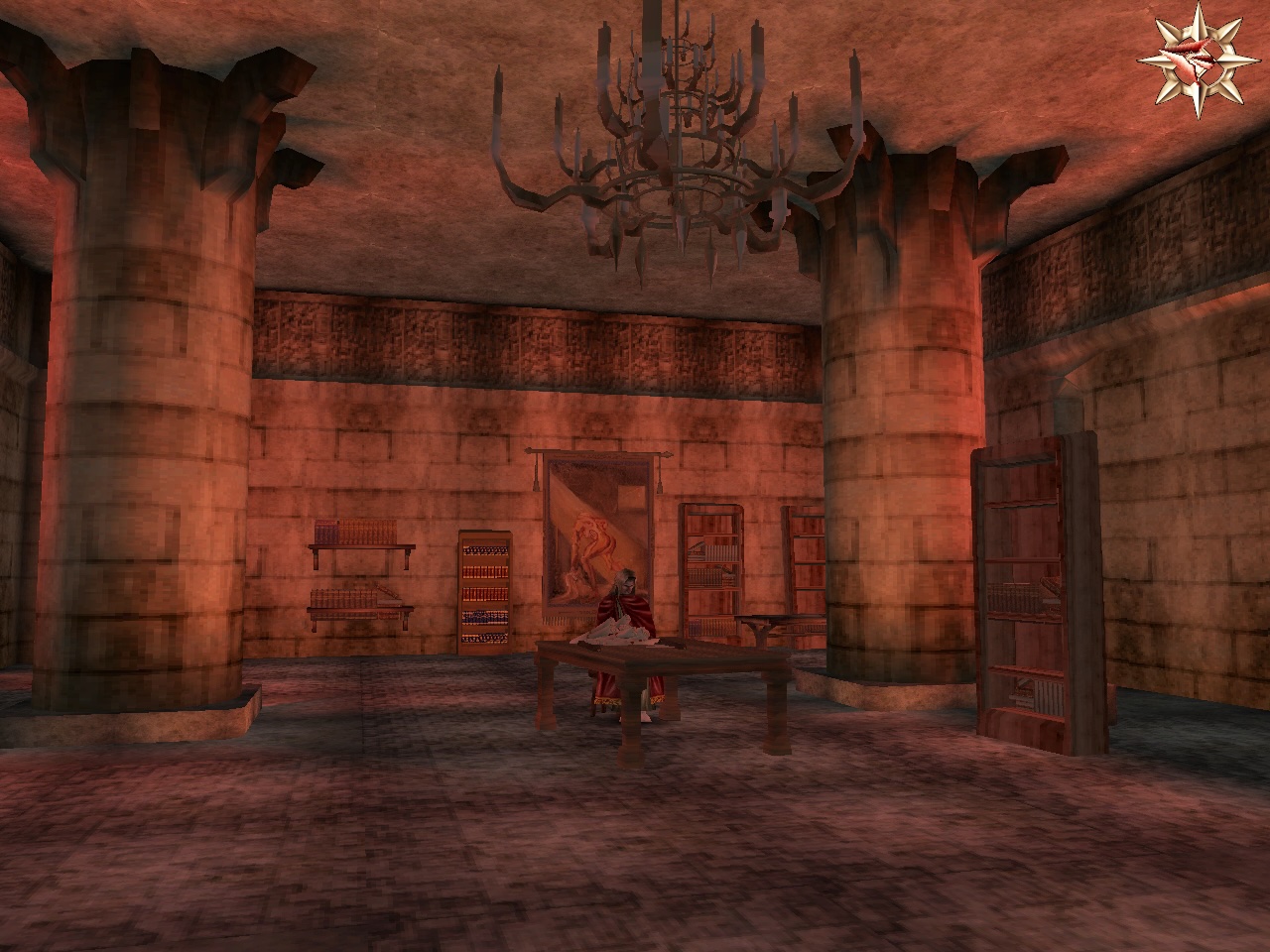
As you explore the empty tech office late at night, sordid secrets are revealed, but the game is most interesting as a knowingly prescient satire of where tech is headed. Or as “Mezzanine”‘s description says, “the lost potential of multimedia and how our current societal psychosis may have always been by design.” Inpatient’s latest game, “Ex Libris,” came out in April and is perhaps the most literary of the bunch. As you make your way past the lo-res ivy and stone lit by the orange glow of firelight, you bump into scattered travelers and locals in the courtyards and chambers: a drunken bookseller, drilling soldiers, a fortune teller and their companion who refuses to speak to you.
You also run into lots and lots of books and scrolls, which you can slowly begin to understand as you “learn” the languages they’re written in and translations begin to appear. The moody music, polygonal characters that feel almost hieroglyphic, and text presented in a mix of English, ancient languages, and invented languages make for a hazy experience. The whole game is eerie and mystical.
The exploration is rewarding, and where this starts to feel less like a game and more like literature. As you raise your “logos” stat and begin to “understand” more of the writing and dialogue, the game’s text begins to form a coherence. The writing in the game is quite good, accurately described as an “amalgamation drawing from Umberto Eco, Francois Rabelais, Clark Ashton Smith, Marguerite Porete, and countless other sources to create an interconnected hypercathedral.” I’m not deep enough into the game yet to say definitively what this hypercathedral looks like, but interesting themes about authorship and memory are beginning to emerge, echoed in the game mechanic of discovering hidden archives and unlocking translations.
Extract — continue reading at the source.

/https://tf-cmsv2-smithsonianmag-media.s3.amazonaws.com/filer_public/65/7a/657afa13-bacc-4442-89f5-6bc5768f670d/1-advers-olavmynten-lacl.jpg)