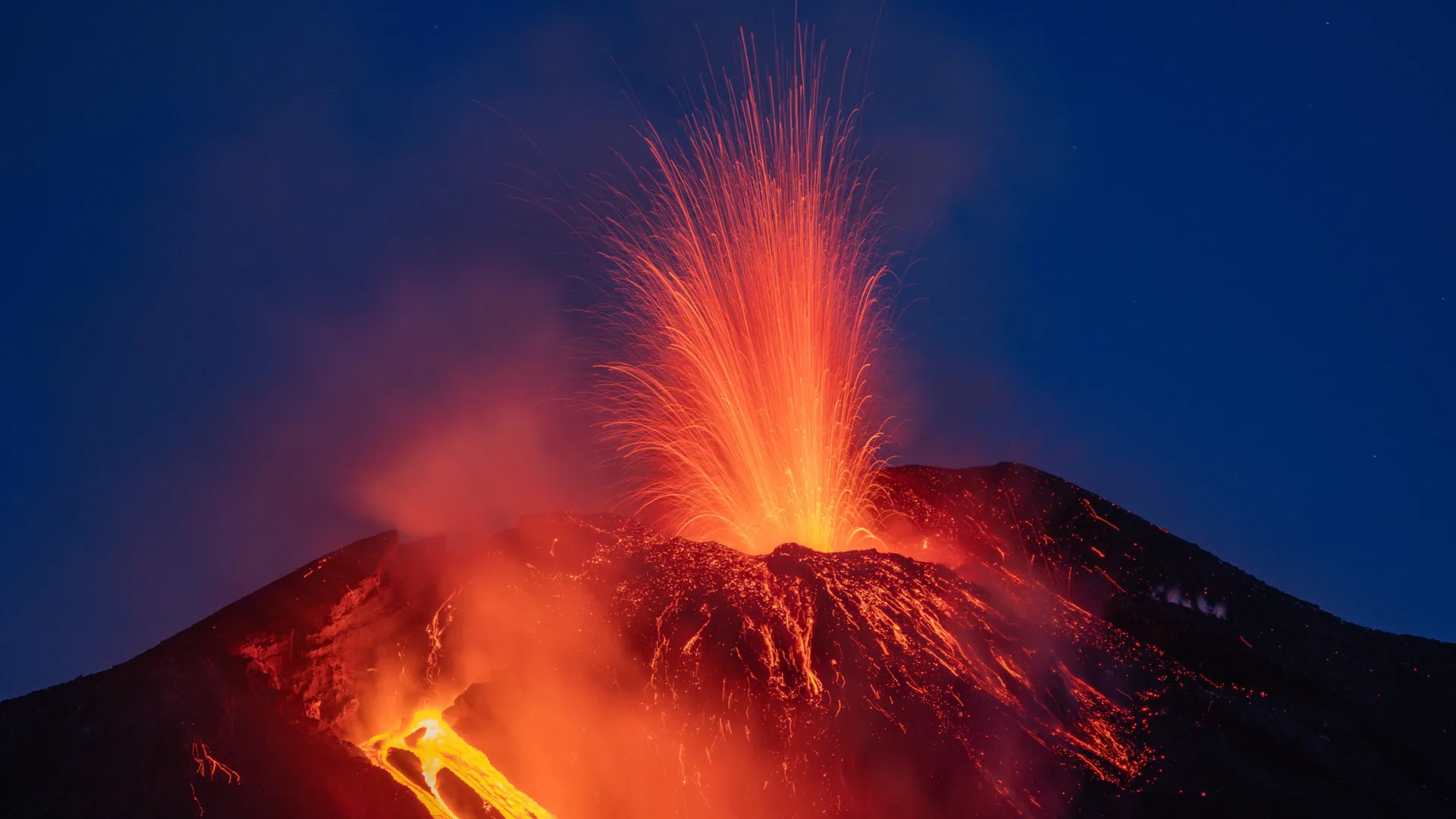
Volcanoes are fed by enormous underground networks of magma and gas, but those systems do not always behave the same way. Even a single volcano can produce eruptions through very different processes. A Cornell-led research team has now shown just how dramatically those pathways can vary at Mount Etna in Italy.
By reconstructing two major eruptions from the volcano's past, the scientists found that magma followed very different routes and moved toward the surface at very different speeds. Understanding those differences, along with the techniques used to uncover them, could help scientists improve models used to estimate the risks posed by future eruptions. The findings were recently published in Geochemistry, Geophysics, Geosystems.
The first author is former postdoctoral researcher Maxim Gavrilenko. The project was led by Esteban Gazel, the Charles N. Mellowes Professor in the Department of Earth and Atmospheric Sciences in the Cornell Duffield College of Engineering.
His research focuses on how volcanoes work, particularly what causes some eruptions to become explosive and which processes control their behavior. A volcano's explosiveness depends on several factors, including how easily its magma flows and the amount of volatile material trapped inside it. These volatiles are gases that can separate from magma as pressure changes.
"Imagine a bottle of soda. If you open that bottle without agitating it, you can drink it, but if you shake it up, all the bubbles get separated really fast, and you have an explosion," Gazel said. "Volcanoes work in a similar way, and my lab is trying to quantify these processes." Two of the most important volcanic volatiles are water and carbon dioxide.
Scientists long considered water the main volatile responsible for driving eruptions. In 2023, however, Gazel's group showed that carbon dioxide can also trigger explosive volcanic activity. The researchers reached that conclusion using a technique they pioneered with Raman spectroscopy.
Extract — continue reading at the source.


