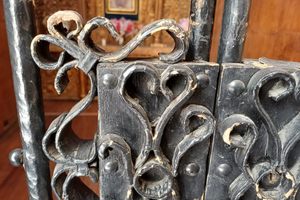
All Mexico Mexico City Papier-Mâché Altarpiece at Plaza Capuchinas This altarpiece isn't a gilded baroque work taken from a church, but rather a recreation where everything (even the fence and lock) are made of paper and cardboard. Cartonería is one of the main forms of artes populares (folk art), also known as artesanías (handcrafts), to come out of Mexico City and its metropolitan area. The terms refers to cartón, what cardboard is called in Mexican Spanish, and cartonería works use a type of papier-mâché technique for their building.
Cartonería is the original medium for judas (figures intended to be burned at celebrations) and alebrijes, and a yearly event called La Noche de los Alebrijes takes place in Mexico City, in which monumental figures are paraded and displayed. As such, the city has several cartonería workshops and noted artists. These groups will often create works with the express purpose of practice, and it seems likely that this impressive reproduction of a Baroque church altarpiece is one of those works.
Martín Rentería, who passed in 2023, and his students' workshop, are one of the likeliest candidates for the authorship of this altarpiece. Rentería was known for realistic works that dealt with Christian themes, which would make this altar fit his oeuvre. Get more unusual and extraordinary places each week with the Atlas Obscura Places newsletter.
Your newsletter subscriptions with us are subject to Atlas Obscura's Privacy Policy and Terms of Use. It is necessary to access Plaza Capuchinas to be able to see the altarpiece, so viewing it is dependent on their opening hours. These seem to be flexible, but generally speaking you can enter the Plaza almost every day from 10am to 7pm.
This 19th century cotton-gin factory has been repurposed into an artist space and cultural center, complete with goats. Artist Veaceslav Jiglițchi brings a connection to Chișinău through works of art. A century-old factory reborn as an artist-run live-work building.
Using primarily recycled materials, artists transformed this house into a colorful piece of art. Founded in 1954 by a husband-and-wife duo, this ceramics studio carries on a powerful artistic legacy. A workshop-turned-museum showcasing the late sculptor's work.
Extract — continue reading at the source.



/https://tf-cmsv2-smithsonianmag-media.s3.amazonaws.com/filer_public/d6/34/d6341e1c-dae8-4784-ad3f-1d375b2dbfb4/gettyimages-2281722380.jpg)
/https://tf-cmsv2-smithsonianmag-media.s3.amazonaws.com/filer_public/06/54/0654ce82-61a8-48c6-aaa0-3474319a638f/sunset-over-bolotana-1536x1024.png)
