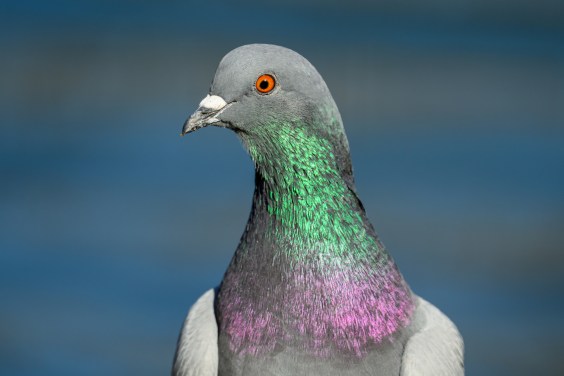
City pigeons have been around since Neanderthals roamed Europe. They served as a valuable food source back then, whereas now they’re decried as a messy nuisance. In fact, some cities have imposed feeding bans in a move to curtail urban pigeon populations.
A recent study published in the journal Royal Society Open Science investigated how pigeons (Columba livia) endure these new food-scarce conditions. Biologists at the Technical University of Munich studied 75 pigeon nests from 20 colonies across three German cities that impose feeding bans: Braunschweig, Munich, and Würzburg. Ten colonies of well-fed pigeons, supplemented with wheat, pea, grain, and grit, served as control colonies for comparison.
Read more: “What Pigeons Teach Us About Love” Both the unfed and fed colonies were visited at least weekly to replace actual pigeon eggs with fake plastic ones as part of regular population control. The researchers accompanied city officials to the swap-outs and collected data on new eggs, including embryo age (estimated by shining flashlights through the eggshells). They also added a weight logger under each study nest to assess activity between visits, including whether a female (lighter weight) or a male (heavier) was incubating eggs.
The data showed that females incubated the eggs substantially more than males when food was available (81 percent of their time on the nest versus just 17 percent of the time for males). That said, when food was scarce, females lowered their incubation effort to 77 percent, while males increased theirs to 22 percent. Basically, the male steps in as needed to ensure the nest remains well-attended under food duress and to give the female a reprieve for foraging.
Or as the study authors put it, “To indulge in mild anthropomorphism, pigeon fathers aren’t ‘lazy’ birds but are arguably preparing for ‘the rainy day.’” Even if this weren’t the case, though, it’s clear that dummy eggs are the smarter (and kinder) choice when attempting to curtail pigeon populations. Subscribe to our free newsletter.
Extract — continue reading at the source.