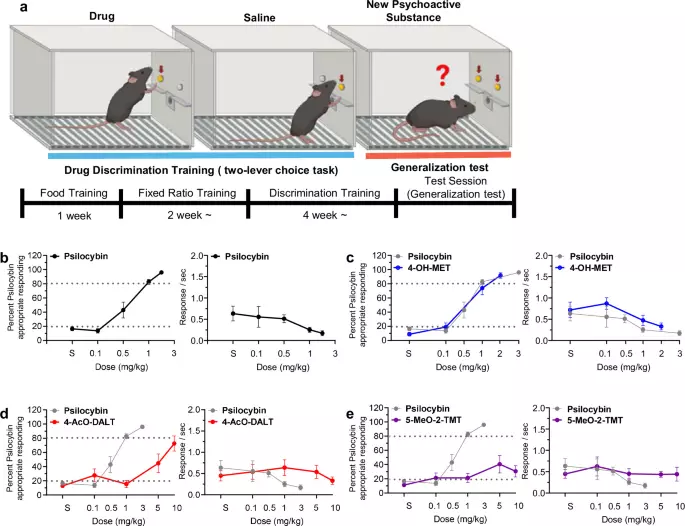
Psilocybin is a serotonergic hallucinogen that acts primarily through 5-HT₂A receptor signaling, yet the mechanisms by which it regulates mesolimbic inhibitory tone remain poorly understood. Here we investigated how psilocybin and structurally related synthetic tryptamines modulate inhibitory signaling in the nucleus accumbens (NAc) and whether astrocyte-associated mechanisms contribute to this process. Psilocybin-like tryptamines that generalized to the psilocybin cue increased NAc neuronal activity while reducing extracellular GABA levels, identifying diminished NAc GABAergic tone as a neurochemical correlate of psilocybin-like behavioral responses.
Consistent with this interpretation, local pharmacological modulation of NAc GABA receptor signaling altered psilocybin-appropriate responding. We next examined the cellular and molecular basis of this GABAergic regulation. Ex vivo whole-cell recordings revealed that psilocin, the active metabolite of psilocybin, reduced tonic GABA current in NAc medium spiny neurons without affecting miniature inhibitory postsynaptic currents, indicating preferential modulation of tonic rather than miniature synaptic inhibition.
Cell-type-specific analyses further showed that psilocybin selectively reduced intracellular GABA levels in astrocytes, but not neurons. Psilocybin increased astrocytic NFATc4 and ALDH5A1 protein expression together with enhanced H3K27 acetylation, and ChIP–qPCR analysis showed increased NFATc4 occupancy at the Aldh5a1 promoter. Consistent with upstream serotonergic signaling, psilocin-induced calcium responses in astrocytes were attenuated by 5-HT₂A receptor antagonism.
Together, these findings support a model in which psilocybin modulates mesolimbic inhibitory tone through astrocyte-associated regulation of NAc GABA homeostasis. Our findings further identify astrocytic NFATc4-associated transcriptional regulation as a mechanism linked to ALDH5A1 expression, astrocytic GABA homeostasis and tonic inhibitory regulation in the NAc. Substance use disorder (SUD) is a major global health challenge characterized by compulsive drug use and profound behavioral dysregulation.
It arises from complex interactions among biological, psychological and environmental factors that shape vulnerability to addiction1,2,3. Alongside conventional drugs of abuse, the rapid emergence of novel psychoactive substances, particularly synthetic tryptamines, has created new challenges for neuroscience, toxicology and public health. These compounds exhibit diverse chemical structures and neuropharmacological profiles, resulting in highly variable and often unpredictable effects on the brain function4,5,6,7,8.
Classical psychedelic tryptamines such as psilocybin and N,N-dimethyltryptamine have long been used in ritualistic and therapeutic contexts. In recent years, a growing number of structurally related synthetic analogs, including 4-OH-MET, 4-AcO-DALT and 5-MeO-2-TMT, have emerged in illicit markets as substitutes for classical psychedelics, complicating both toxicological assessment and mechanistic interpretation9,10,11,12,13,14. While tryptamines primarily act on the serotonergic system, particularly the 5-HT₂A receptor, accumulating evidence indicates that their effects extend beyond canonical serotonergic pathways to influence inhibitory, dopaminergic and glutamatergic neurotransmission15,16,17.
Extract — continue reading at the source.