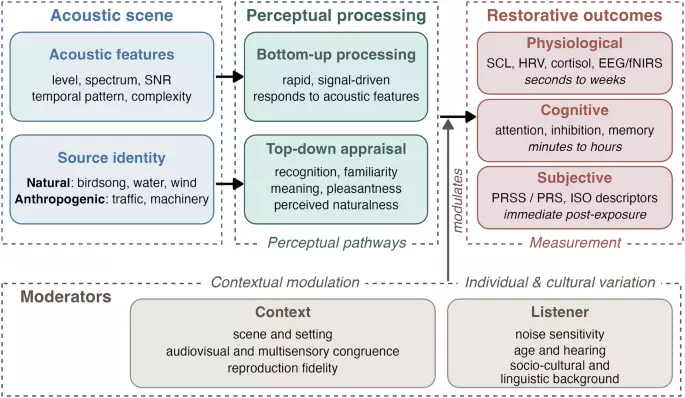
Urban soundscapes can support psychological restoration, but the effect depends on far more than whether a sound is natural. Across psychoacoustics, environmental psychology and neuroscience, restoration is shaped less by source category than by perceived meaning and audiovisual congruence, varies with listener and culture and registers differently across physiological, cognitive and subjective measures. We organise this evidence into a framework and identify where translated measurement tools distort cross-cultural comparison.
Urban populations are increasingly exposed to complex acoustic environments in which chronic noise disrupts sleep and impairs cognitive performance1,2. Whether certain soundscapes can reverse these effects, facilitating what the environmental psychology literature terms ‘restoration’, has become a pressing question for public health, urban planning and building design. Two foundational theories anchor the field: Attention Restoration Theory (ART), which posits that natural environments replenish depleted directed-attention capacity through effortless fascination3, and Stress Recovery Theory (SRT), which emphasises rapid affective and autonomic recovery triggered by positive environmental stimuli4.
Both were developed around visual experience but have been progressively extended to auditory domains. That natural soundscapes such as birdsong, flowing water and wind in foliage tend to support restoration more effectively than urban noise is now well established5, and has been reviewed for natural settings6. The evidence has since grown well beyond natural sound: restorative responses are shaped by what a source means to the listener, by the visual and multisensory scene, by who is listening, and by how restoration is measured, drawing on psychoacoustics, environmental psychology, neuroscience and clinical research.
These strands have largely developed separately, and this review brings them together within a single framework. The review treats variability not as noise but as a central feature of soundscape perception: restorative outcomes depend on how listeners process, interpret and contextualise acoustic information. The aim is to clarify what is known, where evidence converges, and which methodological choices now most strongly shape conclusions for soundscape theory and evidence-based design.
The route from sound to restoration can be described as a chain (Fig. 1). An acoustic scene, characterised both by acoustic features such as level, spectrum, signal-to-noise ratio (SNR), temporal pattern and complexity and by source identity (whether a sound is birdsong, water, or traffic), undergoes perceptual processing that issues in a restorative outcome. Two processing routes operate in parallel.
Bottom-up processing is rapid and signal-driven, tracking acoustic features largely independently of what a sound is taken to mean7. Top-down appraisal is interpretive, depending on source recognition, familiarity, perceived meaning, pleasantness and perceived naturalness. It reflects the constructionist position that restorative potential is conferred by the listener rather than carried by the signal8,9.
Extract — continue reading at the source.