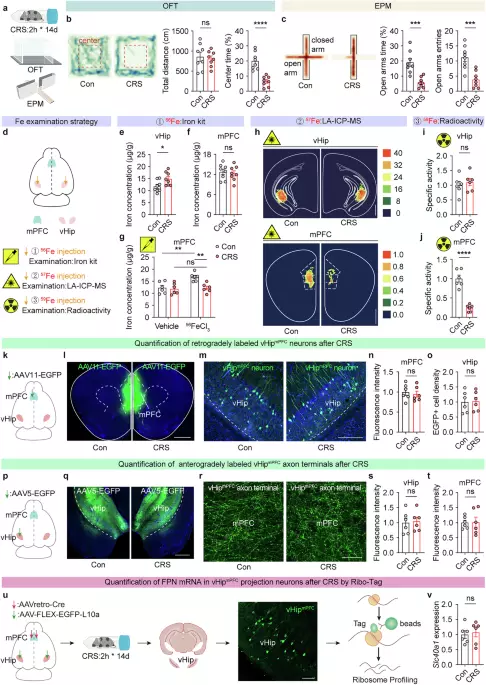
Anxiety disorders affect more than one-quarter of the global population, but current first-line therapies suffer from slow onset and limited efficacy, highlighting the urgent need for novel pathogenic targets. Psychological stress disrupts iron homeostasis in the brain and alters neural circuit excitability; however, the mechanism underlying these two processes remains elusive. Here, we identify a cell type-specific iron signaling pathway between neurons and astrocytes that mediates stress-induced anxiety by regulating synaptic iron transport in the ventral hippocampal-medial prefrontal cortex circuit.
In a chronic restraint stress model in male mice, stress induces activity-dependent HMGB1 expression and release from medial prefrontal cortex pyramidal neurons, which bind to astrocytic TLR4 to stimulate local hepcidin secretion. Hepcidin degrades ferroportin at ventral hippocampal–medial prefrontal cortex axonal terminals in a retrograde manner, blocking presynaptic iron efflux. The resultant iron accumulation in ventral hippocampal-medial prefrontal cortex projection neurons increases their intrinsic excitability via a ferroplasticity mechanism and anxiety-like behaviors.
Notably, intranasal administration of HMGB1/TLR4 antagonists efficiently restored synaptic iron flux and alleviated anxiety in both stress-induced and innate high-anxiety models. Collectively, our findings define a retrograde ferrosynaptic neuroglial coupling mechanism through which stress induces anxiety independently of classical synaptic transmission. This work establishes the HMGB1-TLR4-hepcidin-FPN axis as a druggable therapeutic target and provides a conceptual framework for understanding how iron metabolism operates as a transcellular social coordination system in emotional regulation.
The lifetime prevalence of anxiety disorders is estimated to be more than 25% globally,1,2,3,4 making them among the most burdensome psychiatric conditions worldwide. Despite their profound negative impact on individual quality of life, social function, and societal economic costs, the precise neurobiological mechanisms underlying anxiety pathogenesis remain incompletely understood. While chronic stress is a major risk factor,5,6,7,8 the mechanisms through which it remodels pathological neural circuits remain elusive.
Iron is simultaneously a critical cofactor for synaptic plasticity and neurotransmitter synthesis,9,10,11 and its dysregulation is implicated in a spectrum of brain disorders12,13; however, its operational role in psychiatric disorders, particularly at the level of the synaptic interface, remains elusive. These two paths converge on a central open question: does chronic stress precipitate anxiety by hijacking synaptic iron homeostasis, thereby disrupting neural circuit function? Elucidating these mechanisms is critical for developing more effective therapeutic strategies, as current therapeutic options for anxiety disorders primarily target monoaminergic systems, but approximately 40% of patients show inadequate responses, and the average onset of action is 2–4 weeks.14 Moreover, systemic side effects (e.g., gastrointestinal disturbances and sexual dysfunction) further limit clinical application and long-term adherence.15 Emerging evidence from clinical imaging studies (e.g., quantitative susceptibility mapping MRI) has revealed abnormal iron accumulation in the brains of patients with anxiety,16 but the functional role of iron dyshomeostasis in disease pathogenesis and its potential as a therapeutic target remain unexplored.
This critical gap highlights the urgent need to elucidate the molecular mechanisms linking iron metabolism to neural circuit dysfunction in patients with anxiety, which could lead to the development of novel precision therapies and biomarker-guided interventions. To bridge this knowledge gap, a detailed understanding of how stress signals are transduced into local iron dysregulation within specific anxiety circuits is required. A bidirectional relationship has been established between iron metabolism and stress-related disorders.
Extract — continue reading at the source.