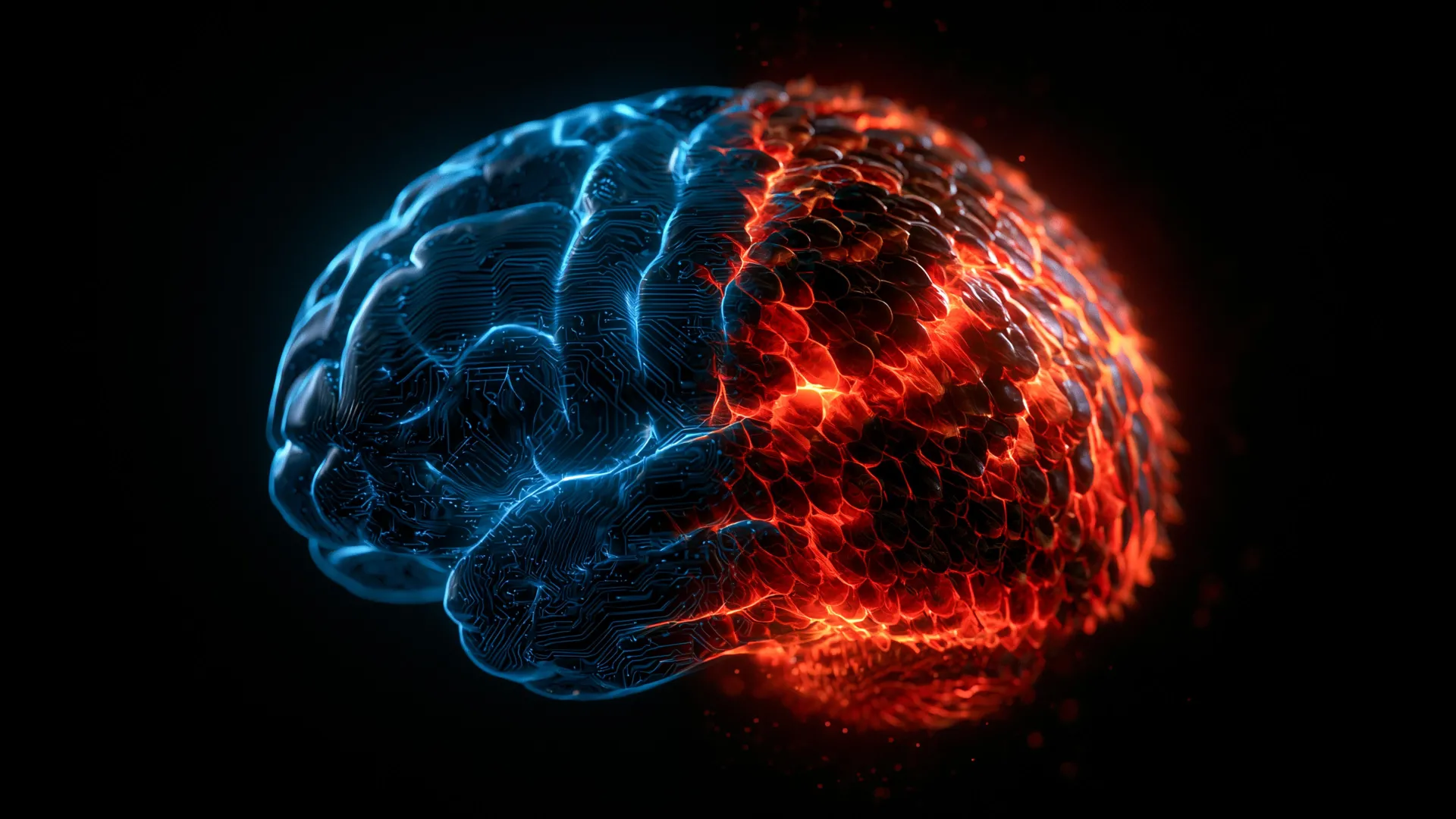
Popular culture often describes that tension as a contest between two parts of the brain: a newer, more advanced center for rational thought and an ancient "lizard brain" that runs on instinct. But the evolutionary history of the brain appears to be far more complicated than a simple struggle between old and new. "There was a theory proposed in the '50s that the brain evolved in layers starting with basic bodily functions, to emotions in the reptilian brain, leading up to sophisticated reasoning in humans," explains Nabil Imam, an assistant professor in the School of Computational Science and Engineering and a faculty member with Georgia Tech's Institute for Neuroscience, Neurotechnology, and Society (INNS).
"This is not how an evolutionary biologist would think about the problem." Research published in Science Advances suggests that brain evolution may be better understood in terms of wiring rather than newer regions being stacked on top of older ones. By examining the organization of both biological brains and artificial neural networks, Imam and his colleagues found evidence that evolution may involve allocating a limited amount of brain space among competing wiring strategies. Their model describes a computational tug of war between two fundamentally different kinds of neural organization, both of which are established even before birth.
The findings could help explain a long-running puzzle in brain evolution and may also point toward new ways of building AI systems that use less data and energy. Why the "Lizard Brain" Model Falls Short Terms such as "logical brain" and "lizard brain" actually refer to groups of brain regions with very different functions. The neocortex, often associated with higher-level thought, forms the outer layer of the brain and is involved in vision, perception, reasoning, and other complex abilities.
The so-called lizard brain is harder to define so neatly. "The limbic system, sometimes called the 'reptilian brain,' controls emotion broadly speaking -- but it also has other components with distinct functions," explains Imam. The system contains separate regions involved in memory, smell, navigation, and emotional regulation.
"Why do people group all these different regions into one big system? There hasn't been a good theory for what is common between these different circuits." To explore that question, the researchers compared how these brain systems change across species. Rather than looking at individual regions one at a time, they examined how the limbic system and neocortex vary together over evolutionary history.
When one part of the limbic system was relatively large, the other limbic regions also tended to be larger. At the same time, the neocortex was generally smaller. That suggests the regions are not evolving independently.
Extract — continue reading at the source.