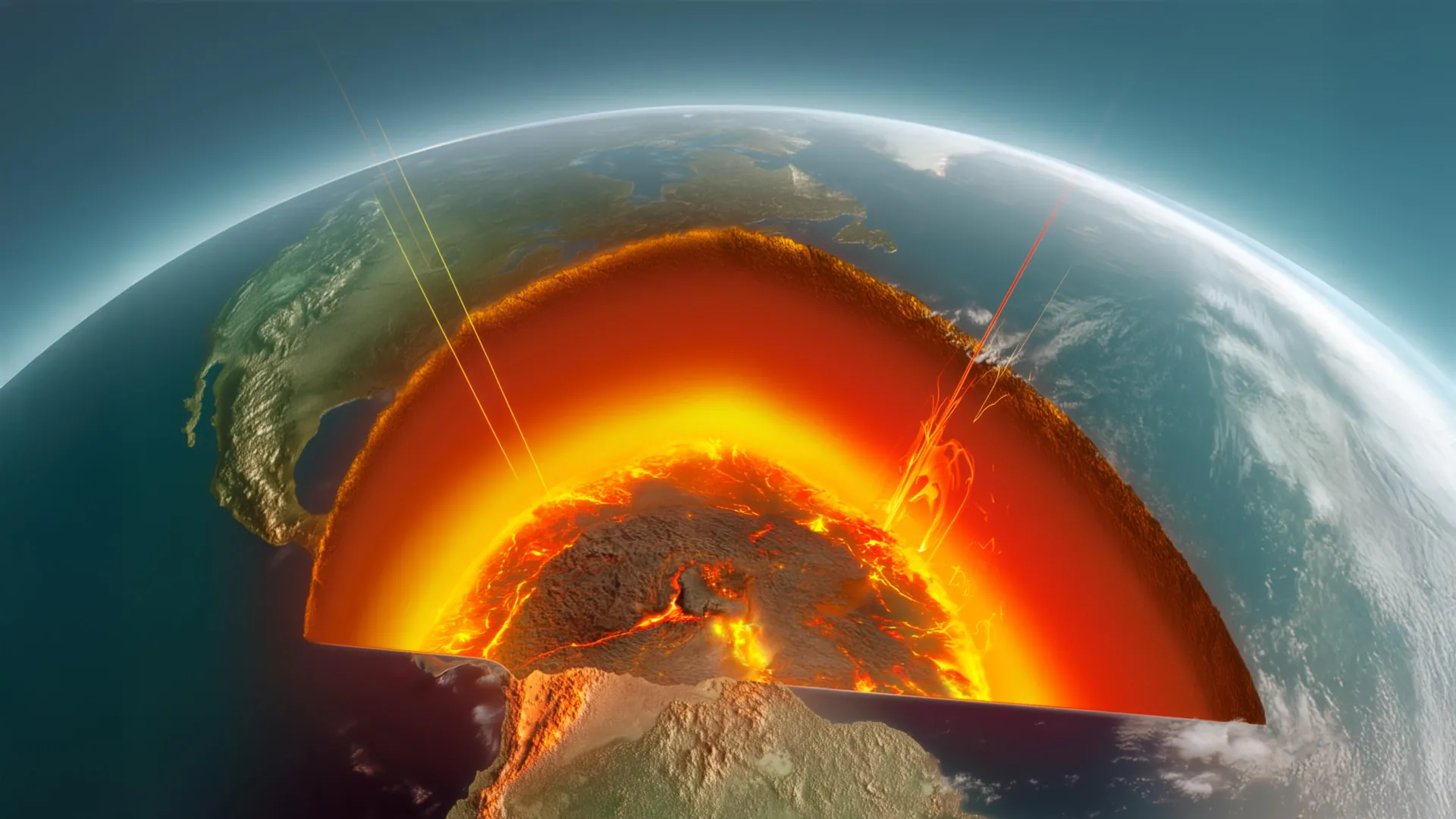
Scientists have discovered that molten rock deep inside Earth can store far more oxygen than previously believed. The finding challenges long-standing assumptions about magma and raises an intriguing possibility: oxygen released from Earth's interior may have helped transform the planet's atmosphere billions of years ago. Through high-pressure experiments and advanced computer simulations, researchers found that magma can absorb additional oxygen beyond the amount normally required by its chemical composition.
This hidden oxygen could provide a previously unrecognized connection between Earth's deep interior, volcanic activity, and the development of an oxygen-rich atmosphere. The research was led by Dr. Ho-kwang Mao of the Center for High Pressure Science and Technology Advanced Research (HPSTAR), working with Prof.
Haiyang Niu of Northwestern Polytechnical University and Prof. Wim van Westrenen of Vrije Universiteit Amsterdam. Their findings were published in National Science Review.
Scientists Challenge a Long-Standing Assumption About Magma Oxygen is one of the most abundant elements inside Earth, accounting for more than half of the atoms in the planet's silicate interior. Silicates are minerals and molten materials composed primarily of silicon and oxygen, along with other elements. They make up much of Earth's mantle and crust.
Despite oxygen's abundance, scientists have traditionally assumed that magma can contain only a specific amount of it. Under this understanding, the oxygen content is determined by the quantities and electrical charge states of other elements in the molten rock, including silicon, magnesium, and iron. Water and carbon dioxide behave differently.
Both can dissolve in magma and later escape as gases when the surrounding pressure decreases. These substances are known as volatile components, and their release plays an important role in volcanic activity. Oxygen, however, has generally not been treated as a separate volatile substance that magma can absorb and release.
Extract — continue reading at the source.