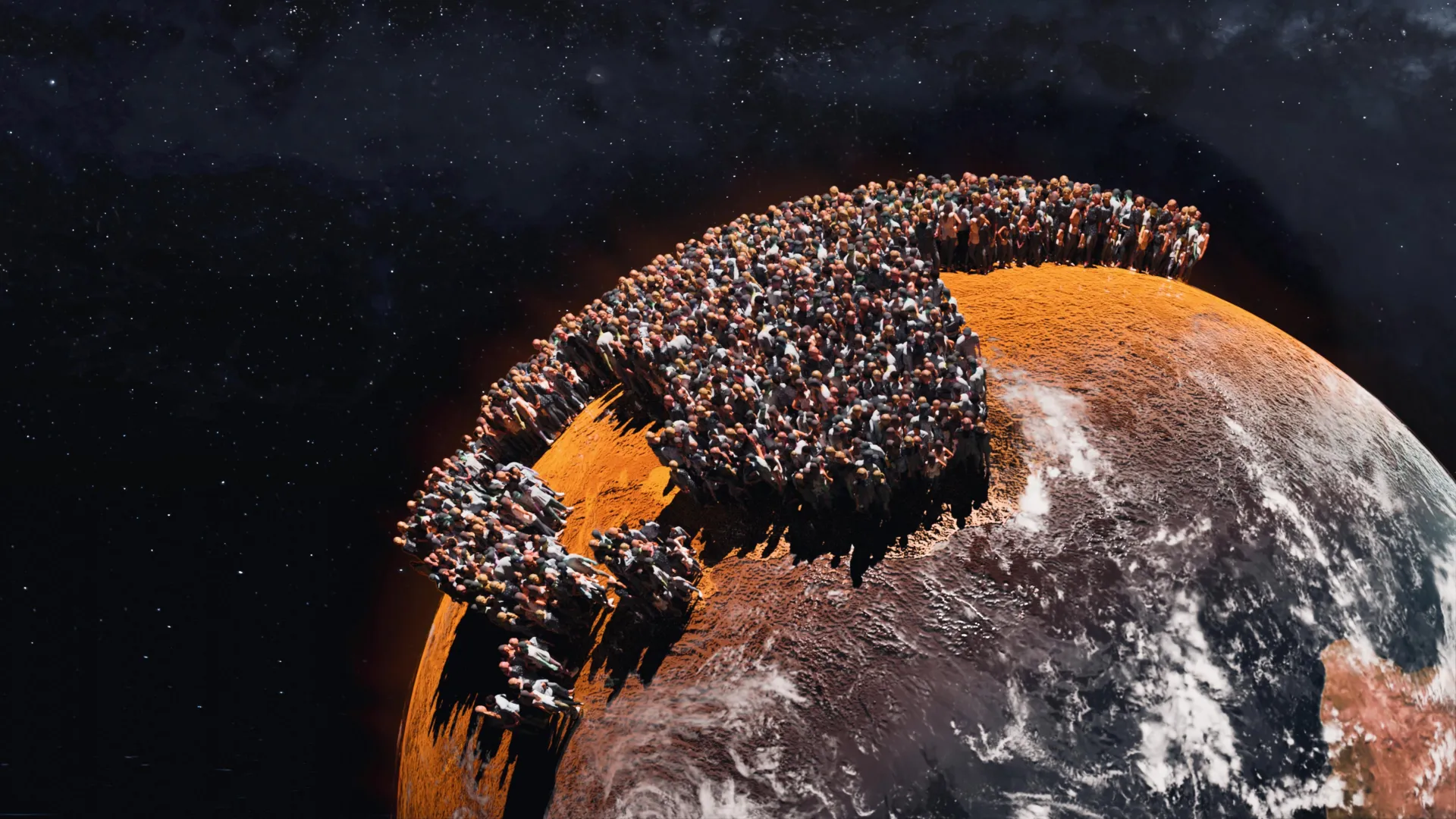
In 1960, Science, one of the world’s leading science journals, published an article with an unambiguous title: Doomsday: Friday, 13 November, A.D. 2026. It predicted that on this future date — less than a month from today — the human population would approach infinity and effectively annihilate itself. The outlandishness of the claim landed the article widespread public attention.
More surprisingly — because its underlying research and math seemed sound — it also received careful and sustained scientific attention. The authors — Heinz von Foerster, an Austrian-American professor and cybernetics expert and two of his students, Patricia M. Amiot — argued that human populations are exceptional and might grow beyond an exponential rate, at an ever-increasing one.
Today, the global birth rate is slightly less than half what it was in 1960. Hopefully, we will all wake up on Nov. 13 to an ordinary day. Nonetheless, this article remains exemplary for blending rigorous science with the art of stagecraft to staggering effect.
The mid-20th century saw increasing societal concern about global population growth and its potential to lead to resource scarcity and geopolitical conflict. Underlying much of this concern was implicit or explicit acceptance of the Malthusian idea that whereas population has the potential to grow exponentially, it is kept constantly under check by its capacity to feed itself. In their article, however, von Foerster and his co-authors argued that as far as populations go, humans may be exceptional.
Given our capacity to communicate and form “coalitions” that help us resolve problems, rising population density might simply mean more opportunities for collaboration, so that our numbers might grow not only beyond an exponential rate but at an ever-increasing one. They then used 24 estimates of the world population stretching across the past 2,000 years to show that human numbers have in fact continually outpaced expectations. All this was presented in calm, scientific prose and aided by dense mathematical equations.
Von Foerster and his co-authors then projected these historical figures into the future, calculating that thanks to ever-increasing growth, in the year 2026 our numbers would near infinity. Thankfully, the same capacity for collaboration that assisted our species’ development throughout history could now avert this catastrophe. Since we are unlikely to want to reduce our life spans, they concluded, we should work together to reduce the global birth rate by half.
Extract — continue reading at the source.