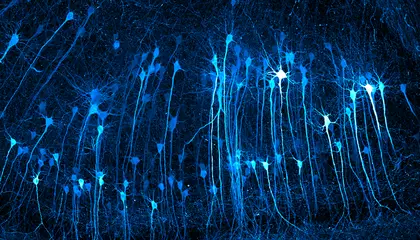
This year’s winners—all captured through a microscope—include zoomed-in shots of slime mold spores, baby sea urchins bathed in fluorescence and everyday writing utensils transformed into enchanted objects. From a pool of more than 1,800 entries submitted from 69 countries, the judges selected 20 winners as well as honorable mentions and images of distinction. Ole Bielfeldt, a student and experimental photographer in Cologne, Germany, clinched first place with his otherworldly shot of a printer in motion—a project he started two years ago.
If you tilt your head slightly, nascent letters start to appear: m-a-c. In full, Bielfeldt was spelling “macrofying,” which is the name of his Instagram account boasting more than one million followers. He then captured the ink-injecting process using flash and his own custom-built equipment.
Bielfeldt, who enjoys turning his lens on seemingly mundane objects, says he was surprised at the messiness of the ink nozzles when he got his first up-close glimpse. The 4th place winner, Justin Theodore Benttinen, also took a surreal look at a ubiquitous object. The photographer from Berkeley, California, snapped the shimmering tip of a ballpoint pen, magnified 20 times.
Kling imaged a 20-day-old sea urchin larva, glittering with blue fluorescence. But several weeks later, the winner, Ning Xu of the National University of Singapore, was stripped of first place, after an investigation found he had not followed proper protocols regarding generative artificial intelligence. (In a now-deleted LinkedIn post, Xu said that A.I. was used in post-production to enhance certain features, but not to generate the film, reported Nature’s Rachel Fieldhouse in September.) In a statement earlier this month, Nikon addressed the change to the rankings in its video contest. It should not be interpreted as a judgment of the entrant’s professional reputation, scientific contributions or intent,” per the statement.
But he’d rather it not touch his art. In the case of the printer, with its internal chaos, he doubts that generative A.I. would have reproduced it accurately. You can see the rest of the second- through tenth-place winners below.
Georgia Michelman is a New York-based science and health journalist and Smithsonian magazine’s current intern from the 2026 class of New York University’s Science, Health and Environmental Reporting Program. Her work has appeared in Science, Knowable Magazine, Live Science and elsewhere.
Extract — continue reading at the source.