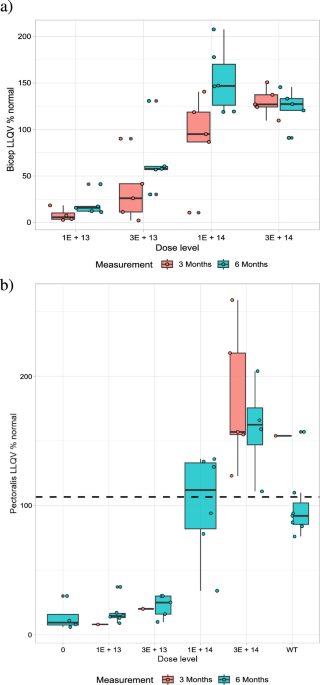
Duchenne muscular dystrophy (DMD) is an X-linked recessive disorder resulting from loss-of-function mutations in the dystrophin gene, leading to progressive muscle wasting and premature death. We present the mini-dystrophin protein expression–function relationship from a post-hoc analysis of mini-dystrophin quantification and function (strength) data at 3 and 6 months in biceps femoris and pectoralis muscles from a DMD rat model (DMDmdx) treated with fordadistrogene movaparvovec, an adeno-associated virus serotype 9 gene therapy containing miniaturised dystrophin. Four treatment groups of ~7–9-week-old DMDmdx rats and two control groups (one wild-type and one DMDmdx group) of ~7–9-week-old DMDmdx rats received fordadistrogene movaparvovec (1E + 13, 3E + 13, 1E + 14 or 3E + 14 vg/kg) or formulation buffer, respectively.
Muscle samples were harvested at 3 or 6 months post-administration. Previously reported treatment of DMDmdx rats with fordadistrogene movaparvovec increased body weight, improved clinical chemistry parameters, ameliorated skeletal and cardiac muscle histopathology and improved muscle and cardiac function, all in a dose-dependent manner. Data from this post-hoc analysis indicate that expression of the mini-dystrophin protein levels is sustained or increased (at lower doses) from 3 to 6 months post-dose in DMDmdx rats treated with fordadistrogene movaparvovec.
Taken together, this suggests a correlation between mini-dystrophin protein expression and function in the DMDmdx rat model 3 and 6 months after fordadistrogene movaparvovec. This is a preview of subscription content, access via your institution Receive 6 print issues and online access Prices may be subject to local taxes which are calculated during checkout Upon request, and subject to review, Pfizer will provide the data that support the findings of this study. Hoffman EP, Brown RH Jr, Kunkel LM.
Dystrophin: the protein product of the Duchenne muscular dystrophy locus. Cell. 1987;51:919–28. https://doi.org/10.1016/0092-8674(87)90579-4. Guiraud S, Aartsma-Rus A, Vieira NM, Davies KE, van Ommen GJ, Kunkel LM.
The pathogenesis and therapy of muscular dystrophies. Annu Rev Genom Hum Genet. 2015;16:281–308. https://doi.org/10.1146/annurev-genom-090314-025003. Werneck LC, Lorenzoni PJ, Ducci RD, Fustes OH, Kay CSK, Scola RH.
Duchenne muscular dystrophy: an historical treatment review. Arq Neuropsiquiatr. 2019;77:579–89. https://doi.org/10.1590/0004-282X20190088. Adeno-associated viral vectors for gene transfer and gene therapy.
Extract — continue reading at the source.