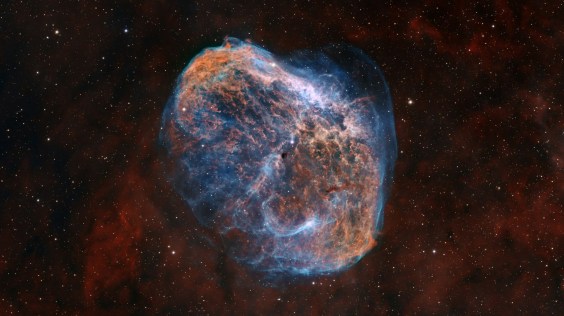
As telescope technology continues to advance, the vistas of space they provide get more and more impressive. Case in point: this awe-inspiring shot of NGC 6888, better known as the Crescent Nebula, some 5,000 light-years away from us. It wasn’t taken by a telescope in orbit or by an observatory on Earth, but by solo astrophotographer Kevin Boardman, using a TEC 140 telescope in his backyard in Richardson, Texas.
It took more than 17 hours to capture the image, spread across five nights, using narrowband filters that isolate specific wavelengths of light as they’re given off by ionized gas. That photogenic gas is courtesy of a dying star known as WR 136. It’s a Wolf-Rayet star, meaning it’s late in its life and erratic, with winds so powerful it’s started shedding its hydrogen, giving off a distinctive light.
The unusual spectra is caused by two waves of stellar wind, an older and slower one colliding with a newer and faster one as WR 136 breaks apart over hundreds of thousands of years. WR 136 itself is visible near the center of the nebula—it’s the bright white dot. The swarming bubble of gas and dust around it is roughly 25 light-years across.
This will all come to a dramatic end when WR 136 explodes in a supernova, which will provide a different celestial light show. The colors, applied during image processing, show where the energy is: The blue is the outer shell of the nebula, made up of oxygen atoms stripped of their electrons (ionization), and the red filaments are where hydrogen ions are grabbing their electrons back. It’s a cosmic whirl, powered by the ultraviolet light flooding out from WR 136.
The photo was initially captured in monochrome, filtered to catch specific elements—oxygen and hydrogen in this case. That’s why other shots of NGC 6888, like this one from NASA, look slightly different—they’ve been processed in a different way. In Boardman’s photo, the red haze around the nebula is more interstellar hydrogen spanning thousands of light-years, ionized by the hottest young stars of the Cygnus constellation, and glowing as it recombines and recovers its lost electrons.
Another feature you might notice is what looks like a boulder blocking the light near WR 136. Astronomers think it’s a denser clump of gas and material pushed out from WR 136 by its stellar winds. If you want to try to take such an image yourself with a telescope in your backyard, the good news is, you have plenty of time to get it right—WR 136 will be sticking around for another 100,000 years or so.
Extract — continue reading at the source.


/https://tf-cmsv2-smithsonianmag-media.s3.amazonaws.com/filer_public/d6/3a/d63ab0e1-1057-4fce-8f8c-c0ea8bb2ea6e/a_1-fused-groups-of-anglo-saxon-coins-found-in-recent-excavati-95fcea8df7df53c8c8b6485cc9f1e443.jpg)