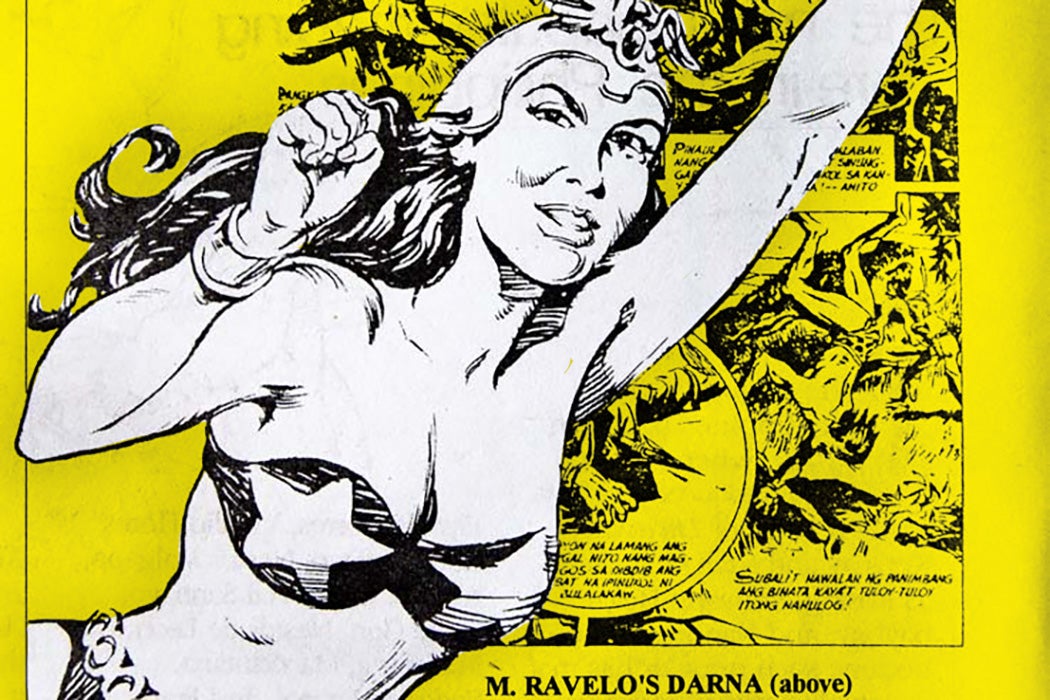
Sporting a winged tiara and star-spangled bustier and gifted with superhuman strength and flight, Darna could be called the Filipino version of Wonder Woman. But unlike the Amazon princess, she’s also a family-minded village girl. Created in 1950 by the prolific Mars Ravelo, Darna demonstrates some of the folk values that have made comic books, or komiks so popular in the Philippines, according to Soledad S.
Komiks offer readers “exceedingly accessible modes of retelling stories that belonged to the lore of the common people—their myths, epics, legends, and tales,” Reyes says. With Kenkoy, which ran in the Tagalog magazine Liwayway (Dawn), “a whole new world of reading was introduced, where visuals served a key role in helping the reader follow the narrative.” Reyes describes the titular protagonist as a “product of the American era”—a materialistic opportunist clad in “modern attire” like wide pants, who “spoke in ‘carabao English.’” But beyond depicting local responses to colonial modernity, Kenkoy also reflects the persistence of figures familiar from traditional folktales, according to Reyes. She views Kenkoy, “who resorted to tricks and gags to get what he wanted,” as echoing other trickster figures like the mouse-deer Pilandok, who outwits more powerful antagonists.
Komiks enjoyed a heyday after World War II, which Reyes ascribes in part to “writers’ desire to juxtapose the idealized world of the komiks against the misery and despair” around them. During the postwar era, writers and audiences continued to turn to the colonial and precolonial past for inspiration. The Tarzan-like Kulafu, who first appeared in Liwayway in 1933, was joined in the 1950s and 1960s by medieval knights and native warriors.
As the space age raced on, Western media influences also brought “terrifying robots and other creatures from outer space” to 1970s titles like Star Boy and Star Lad. Still, these science-fiction stories appeared alongside “narratives that resurrected a number of preternatural creatures from our legends and myths” like the aswang. For Reyes, the popular appeal of the komiks stemmed not from their wide-ranging plots or exotic settings but from their consistent affinity with the Filipino underdog.
Their iconic characters are “characterized by a deep sympathy for the plight of the powerless”—a trait that resonated all the more when public institutions were perceived as unable to save the masses from oppression by landlords, criminals, disease, and hunger. To attract new readers, creators began incorporating elements from other popular media, including Japanese adventure anime. Dragon Ball Z and Sailor Moon are among the more recent influences on creators working within a tradition that has long drawn from a wide range of foreign cultures.
But beneath these changing influences, Reyes finds that “the lore of the folk”—Filipino myths, legends, and epics—remains “a dominant stream that has continued to sustain the komiks until now.” As she concludes, “In a country desperately in need of heroes and manifestations of deeds that transcend self-interest, the komiks offer themselves as possible sources of qualities that common people perceive as the stuff of heroes.”
Extract — continue reading at the source.