It was the autumn of 1865—a quiet, bitter autumn after four hollowing years of war—when James Gilmore received a manuscript from a ghost. Well, not a ghost exactly. There’d been rumors, of course, about what had become of William Parker.
Some had him lynched in a dark woods. Others had him hacked to pieces in New York City. Still more had him living long enough to slaughter Confederates on Southern battlefields.
But it had been nearly a decade and a half now since Parker vanished, and no one could ever truly prove what had become of him. America in 1851 was held together by the thinnest of compromises. The Mason-Dixon Line served not just as a demarcation separating the slave South from the free North but also as a fault line for a nation threatening to break itself in half.
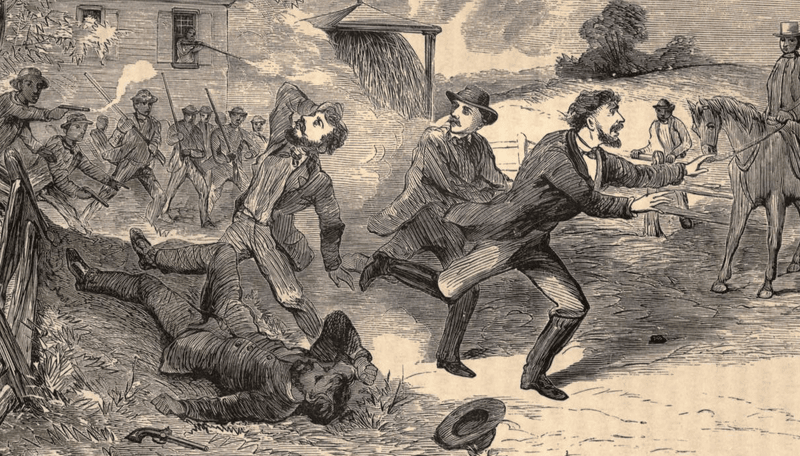
Here, less than a day’s ride from that infamous boundary, a festering hostility toward the slave-catchers who stalked the hushed, racially integrated villages of rural Pennsylvania finally tipped over into what those involved would later call a “battle.” This bloody standoff between enslavers and the formerly enslaved captured the attention of a deeply divided nation, filling newspapers with lurid accounts. There are besides twenty others dangerously wounded.” “There were four men, all armed with pistols, it is true,” the Baltimore Sun assured its readers, “opposed to about one hundred infuriated, blood-thirsty, howling demons.” As the story unfurled, it showcased many familiar archetypes of a pre-Civil War America. There was Edward Gorsuch, the wealthy Maryland plantation owner and church elder; his handsome young son; and the bombastic Philadelphia police officer they’d hired to lead them through unfamiliar territory in search of four men who had, in essence, stolen themselves to freedom.
In the North, the story intersected with a surprisingly diverse society of radical abolitionists: well-known figures like Frederick Douglass, William Lloyd Garrison, and Lucretia Mott; but also Philadelphia’s wealthy Black elite, obstructionist Quaker farmers, and the Black rebels themselves, led by their enigmatic leader, William Parker, a man whom it was rumored bullets could not kill. But the manuscript in James Gilmore’s hands that day revealed elements of this story never before shared: the origins and outrageous adventures of Parker’s armed Black mutual defense organization; their alliance with various white neighbors, including those who would be arrested alongside them in the battle’s chaotic aftermath; and finally, the daring narratives of Parker’s escapes, first from slavery and later from the enraged mobs and hastily deputized law enforcement officers who wanted to make good on the $2,000 bounty the governor of Pennsylvania himself had placed on Parker’s head. The U.S. government descended on Parker’s small town.
Cattle cars would be used to ship dozens of Christiana men to a Philadelphia prison, where they would be charged en masse with “levying war” against their nation—the largest federal indictment in the country’s young history. The president himself would direct the prosecution’s strategy from the White House, while the fearsome wit of congressman-attorney Thaddeus Stevens would bolster the defense. Each side aimed to sway the twelve white men on the Philadelphia jury as to what should be the fate of these traitorous “rioters”—and whether the only way to save an already riven nation was to set a proper example and send them to a hangman’s noose.
Extract — continue reading at the source.