When and how prehistoric humans came to the Americas has been the subject of some heated debate. For the latter half of the 20th century, it was thought that the Clovis people arrived first around 13,000 years ago. Beginning in the 1990s, the discovery of a slew of older sites—some as far south as Chile—seemed to upend that theory.
Now a new study published in Science Advances is providing new fodder for debate—as well as some intriguing common threads between pre-Clovis and Clovis cultures. A team of archeologists conducted a comprehensive survey of an ancient human settlement called Shég’ Xdaltth’í’ (pronounced shehg xuh-tuhl-TTH’EE) in Alaska Native Athabascan (which means “they were here”). The 13,800-year-old settlement is located on a windy bluff overlooking the Tanana River Valley in central Alaska, part of a vital corridor for prehistoric humans making their way through Beringia.
The researchers conducted radiocarbon dating of the oldest sediment layer, analyzed the remains of plants and animals found there, and examined a staggering number of artifacts—more than 80,000 altogether. Read more: “The Greatest Journey of All Time” Far from being a brief stopover, the team says the site was a base camp, inhabited by prehistoric humans on and off for over two centuries. An oval dwelling with a hearth and an earthen oven showed evidence of cooking and discarded bones indicate they dined on mammoths, birds, hares, and other animals.
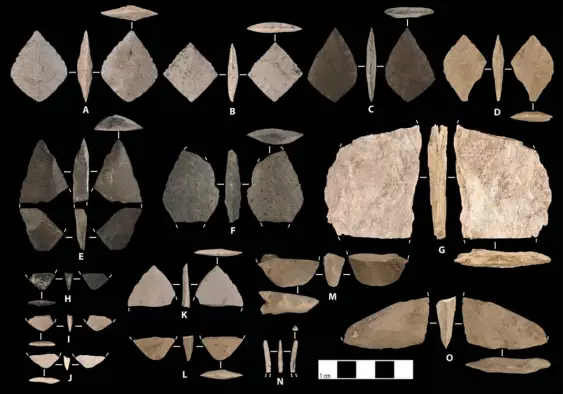
Some of these bones had been fashioned into fine tools like sewing needles and awls, which would have come in handy for stitching together animal hides to survive the harsh winters. They team also found an antler pendant, potentially decorative red ochre pigment, and the jawbone of a canid, which could indicate the ancient inhabitants were dog owners. But most interesting were the stone tools, especially a collection of unique bipointed, diamond-shaped biface axes, which resemble those found both in western Beringia and northeastern arctic Siberia.
According to the team the parallels point to a cultural connection that stretches across the Bering Strait. And just as remarkable were the stone tools they didn’t find: microblades. These stone-flake points with parallel sides were common in eastern Beringia sites around the same time, as well as other sites in Siberia.
However, there doesn’t seem to be a connection between the microblades and the fluted points of paleoindian cultures much farther south. Instead, these cultures seem to use the same edge ground hafted biface technology discovered at Shég’ Xdaltth’í’. The similarities between the cultures don’t stop there either.
Extract — continue reading at the source.