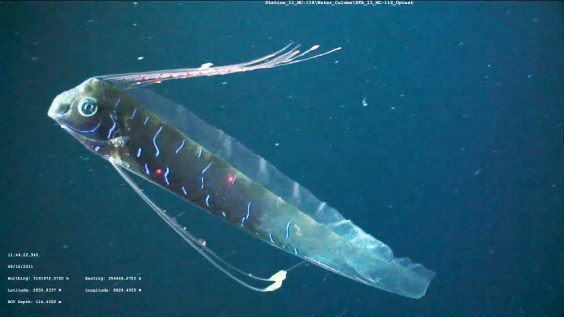
Sailors spotting sea serpents might not have been telling tall tales. The oarfish, with its blank eyes, feathered crest, and snakelike body that can grow more than 25-feet long, is a dead ringer for some of the horned serpents you see adorning ancient maritime maps. When a 16-foot long specimen washed up on shore in Bermuda in 1860, there was no doubt it was some kind of sea monster.
And it’s not just Western cultures that find the elusive oarfish spooky. In Japanese folklore, oarfish are considered messengers from the palace of the sea god, but they have another name there as well: the doomsday fish. That’s because sightings of the eerie fish are considered harbingers of natural disasters like earthquakes and tsunamis (a 2019 study of newspaper reports uncovered no link between the two).
One quick glance at these fish swimming, and you can understand how they might be mistaken for possessing supernatural abilities. Instead of undulating their bodies back and forth horizontally, they float vertically in the water column, completely still except for the shimmering waves of their elongated dorsal fins. It’s a haunting sight. (In fact, their regal bearing is what gives the oarfish its genus name, Regalecidae.) “Most fishes with long bodies swim like eels.
They move in a series of undulations, pressing the water back and forth,” Willy Bemis of Cornell University, author of a new study on oarfish locomotion explained in a statement. Specimens of these fish are hard to come by because they tend to break apart once they’re at the surface. The team, led by Cornell biologists, got their hands on eight giant oarfish from a variety of museums and other institutions.
They studied the specimens in-depth, dissecting them, scanning them with X-rays, and looking at the microscopic structures of the fin. They found that the sites where the individual fin rays attach to the body had a unique structure—a ball-and-socket joint providing 360 degrees of movement, like a joystick. According to the team, this allows the fish to change direction quickly and quietly while stalking prey.
The oarfish’s movement is being considered as a biological blueprint for underwater robots to monitor ocean health. Basically, the fish that moves via biological joysticks could one day inspire robots controlled by digital joysticks. Subscribe to our free newsletter.
Extract — continue reading at the source.