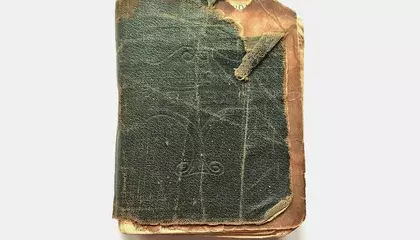
The day the boy found the diary, he’d been scrounging for treasures at the local dump in Stourbridge, England. He and his friends had entered through a small opening at the bottom of a wire fence. Then they spotted something among the bottles and cans: a nearly four-inch-long volume with a green cover, its pages turning in the wind.
The year was 1965, but the diary entries dated to 1918. Their author was a man named Corporal Claude Nuttall, who had served as an infantryman (or “Digger”) in the Australian Army during World War I. He met his wife, Violet Palfreyman, while recovering from an injury in an English hospital.
Weeks after the wedding, he returned to the front. Did Nuttall ever make it home? The boy wondered about the soldier’s fate, and the diary offered several ominous clues.
The corner appeared to have been pierced by a bullet, and its pages were stained with blood. Nuttall’s last entry was dated August 10, 1918. The pages that followed were blank.
Push still in progress,” he wrote. Prisoners still coming back. Wrote to Violet.” The diary eventually made its way to Colin Reid, a former curator at the Dudley Museum and Art Gallery in England’s West Midlands, who spent decades researching the soldier’s story.
The culmination of his efforts is the book The Digger’s Diary, which comes out this fall. The fact that his diary was unfinished, bloodstained and had been punctured by a bullet compelled me to find out if he had survived and returned back to Violet.” The story of the diary’s discovery begins with the Stourbridge dump. The boy who found the volume was 12-year-old Alan Southall, who held onto it for three decades.
Extract — continue reading at the source.