Donald Trump’s remarks concerning the British and Argentinian claims to the Falkland Islands have created friction with the United Kingdom and put wind in the sails of his ally Javier Milei—while also hinting at the president’s calculus when it comes to the United States’ regional and global interests. The Falklands are a self-governing British Overseas Territory in the south-west Atlantic Ocean, whose citizens are seen almost universally as British both within and outside of their borders. But Argentina, which refers to them as Islas Malvinas, claims sovereignty over the islands—a long-running area of diplomatic dispute which erupted into war in 1982.
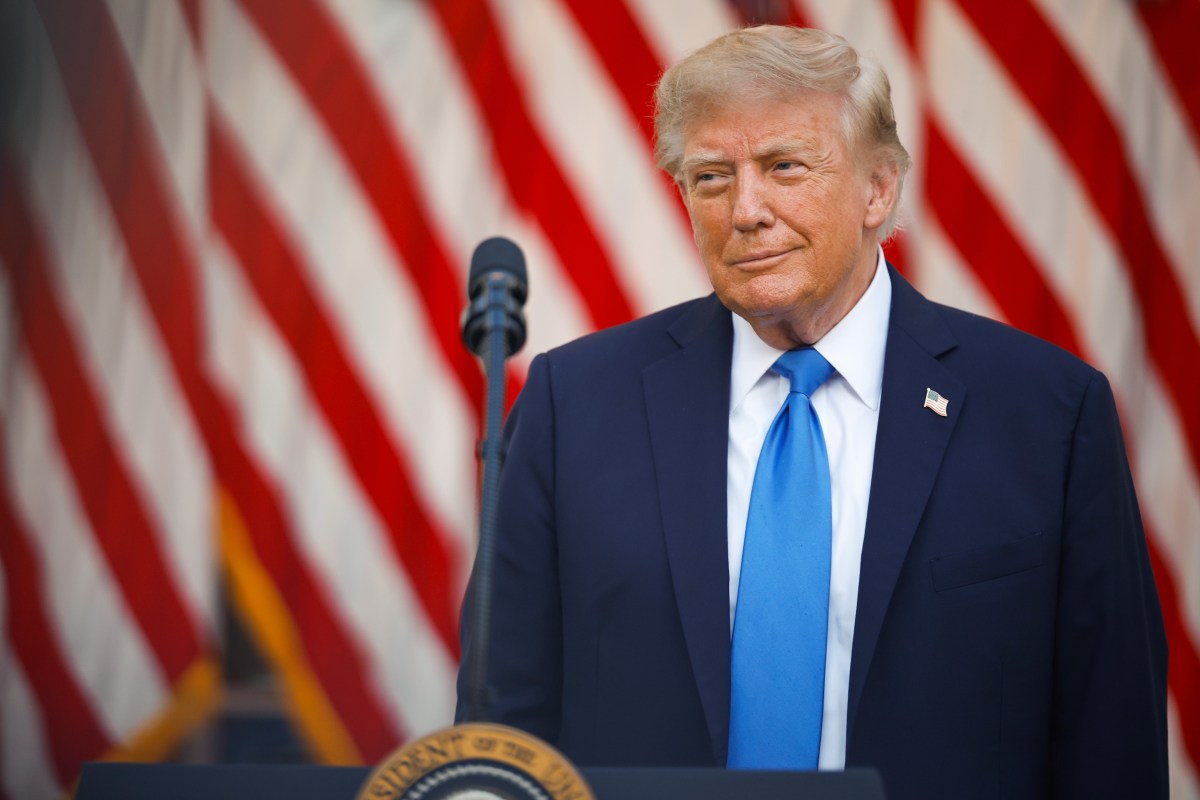
After Argentina invaded the islands, the resulting 74-day conflict led to the deaths of 255 British and 649 Argentine soldiers, as well as three islanders. And into this ever-tense arena entered Trump this week, when a reporter asked the president about the U.S. position on the islands—still officially one of neutrality—during an event at the White House. Trump followed up Monday’s remarks with the suggestion, made during an interview with the British channel GB News, that the U.S. would not back the U.K. if Argentina again tried to stake its claim to the islands by force.
After responding to a question on coming “to the aid of the U.K.” by stating that the islands are “a long way away” from Britain itself, Trump turned to the Iran war and told the interviewer: "Your country was not there to help me. We didn't need help, but I did ask NATO, and I asked your former leader, 'why didn't you send a couple of ships?'" The remarks have been seized upon by Argentina’s president—a firm proponent of his country’s claim to the islands. In a televised address to the nation on Friday, translated by Sky News, Milei said that he would sanction oil companies working in the region, that Argentina would “need to recover” the Falklands, and that the issue was “above any political difference” in the country.
A day after Trump’s GB News interview aired, Milei told his country that the “winds of change” were blowing in Argentina’s favor when it came to the Malvinas. And Trump’s apparent decision to side with a regional allied power over a stalwart historical ally appears to align with the geopolitical worldview that has come to define his second term in office: The Donroe Doctrine. A play on the 19th century Monroe Doctrine, the label has come to describe America’s recent more assertive approach to the Western Hemisphere.
But the remarks and any support this gives for the Donroe interpretation of Trump’s geopolitics also seem to represent a further departure from the longstanding “special relationship” between the U.S. and U.K. As well as the military foray into Venezuela and the ousting of its president—now apparently giving way to a comprehensive energy exploitation plan which appears set to heavily benefit the U.S. market—the U.S. has also increasingly put limiting Russian and Chinese influence within North and South America as one of its top strategic priorities. In statements to the British press following Trump’s remarks, a spokesperson for Prime Minister Andy Burnham said that the U.K.’s support for the islands was “unwavering.” “The Falkland islanders are British, with the right to determine their own future,” the statement read.
Defense Secretary Wes Streeting likewise described his country’s commitment to the islands as “absolute and unshakeable,” while Foreign Secretary Ed Miliband wrote on X that the islanders’ “right of self-determination is paramount, grounded in international law and we will resolutely uphold it.” But despite the country’s own “unshakeable” and “unwavering” position, a YouGov poll of 4,833 British adults conducted this week showed that only 16 percent had “a lot” or “a fair amount” of confidence that the U.S. would “come to Britain's aid if the UK or its dependent territories faced a military attack?” This compares to 33 percent and 37 percent, respectively, who had “not very much,” or “no confidence at all.” Contact Newsweek editor on this story: Edward Pearcey.
Extract — continue reading at the source.