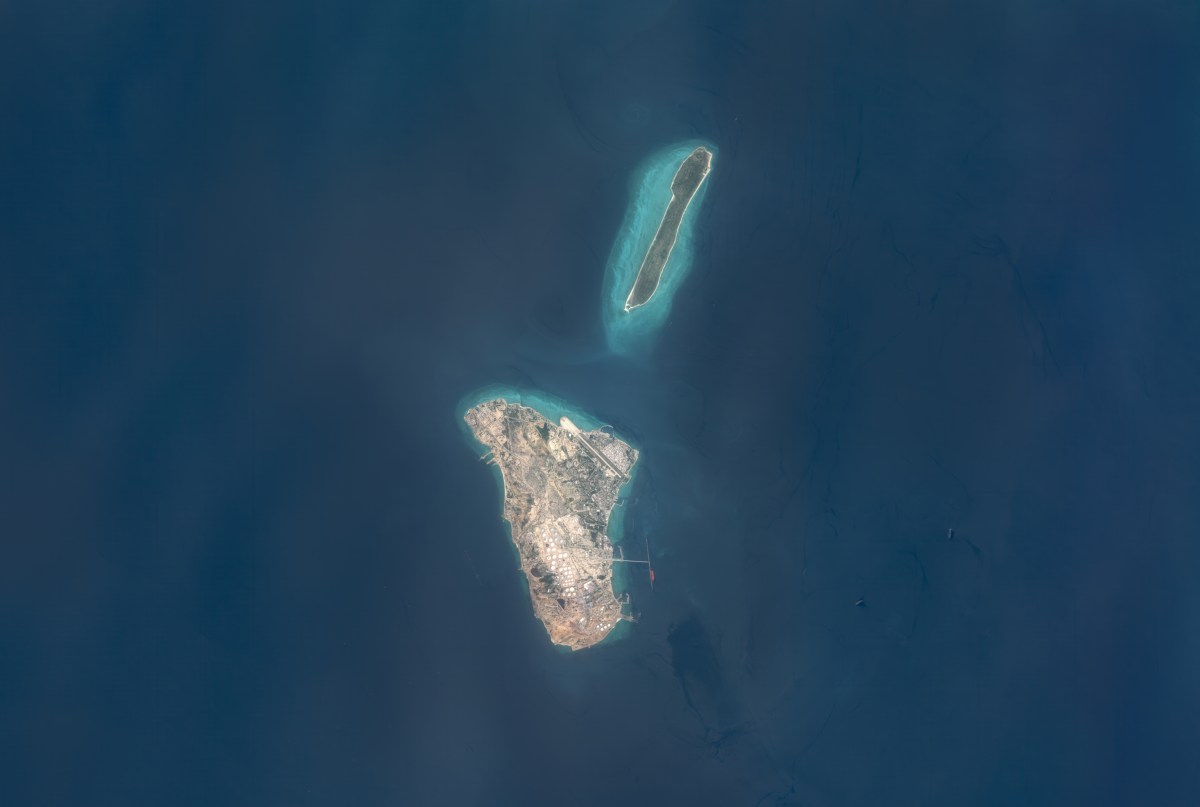
The United States struck three Iranian oil tankers on Saturday, U.S. Central Command (CENTCOM) has confirmed, which it said were involved in covert oil shipment near the critical Kharg Island terminal. Only one of the vessels was near Kharg Island.
In addition to one vessel “permanently disabled” off the coast of Kharg, Centcom said it had “completely destroyed” another oil carrier near the port city of Jask, while rendering another “inoperable” in the Gulf of Oman “after the crew was directed to abandon ship.” Early on Saturday, Iranian state-linked media reported that one of the country's oil tankers had been struck by U.S. forces, in apparent response to Iran firing missiles against American vessels in the Strait of Hormuz. CENTCOM has now confirmed these details, and said that its strikes were prompted by Iran's Islamic Revolutionary Guard Corps (IRGC) launching "ballistic missiles toward two U.S. Navy warships patrolling regional waters." CENTCOM said that the U.S. vessels evaded the "unprovoked" attacks and that no American personnel were injured as a result.
While CENTCOM said that the Iran strikes which preceded its retaliation were “unprovoked,” this comes after the two sides traded strikes for the first time in several weeks around Larak Island in the Strait of Hormuz. In late August, the IRGC said American forces killed two in what CENTCOM described as “limited, precise action.” "The three Iranian crude oil tankers are part of a multibillion-dollar shadow network that funds the IRGC and its regional proxies. Iran has no means by which to defend them," according to the CENTCOM release.
As CENTCOM said on Saturday, the three Iranian vessels were involved in Iran’s “multibillion-dollar shadow network.” Iran’s “shadow fleet” has for years been on the radar of the U.S. military. Weeks into Operation Epic Fury—the code name for the joint U.S.-Israeli military operations against Iran which began on February 28—American forces began intercepting what the military called “shadow fleet vessels.” And a significant element of Bessent’s “D-Day” strategy is aimed at Iran's petroleum industry and its maritime transport networks. The Treasury sanctioned brokers, shipping companies and vessels accused of helping move Iranian crude oil and petroleum products through so-called shadow fleet operations.
Officials identified several tankers they say transported millions of barrels of Iranian oil despite existing restrictions. The escalation comes amid an attempted U.S. pivot toward economic over military pressure. Washington announced a new sanctions strategy in August aimed at economically isolating the country, which President Donald Trump and his Treasury Secretary Scott Bessent have dubbed an “Economic D-Day.” Bessent described this as "the single greatest financial offensive ever marshalled against an adversary" in an opinion piece for The Financial Times, and later told CNBC the plan would “collapse” Tehran’s government.
An IRGC-linked Telegram channel posted about the attack, sharing CENTCOM’s footage of the strikes while calling the command a “terrorist organization.” Contact Newsweek editor on this story: Edward Pearcey.
Extract — continue reading at the source.