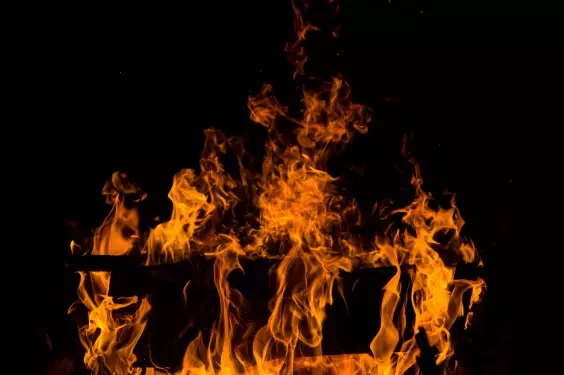
Communing around a fire entwines humanity in a yarn stretching back to our hominin ancestors, who stoked these embers of storytelling. And those nightly fires could have been the hearths from which early language emerged. Hominins began taming fire around 1.5 million years ago, and by 400,000 years ago hearths were more common as our ancestors used fire to chase away darkness at night.
The glowing little world that a fire creates around itself, painting cave walls and the faces of our companions in warm hues and lively shadows, calls us in to lean closely and listen. This environment may have ignited a shift from our ancestors communicating about the world around them, to narrating things they could not see. Communication moved from something like the gestures great apes use today, like chest-beating or baring their teeth, toward a simple proto-language that was a step toward modern language, according to an anthropologist and a primatologist who published their theory last month.
Read more: “Human Ancestors Were Using Fire Earlier Than Previously Thought” “Storytelling really is core to human evolution,” said Robin Dunbar, an emeritus professor of evolutionary psychology at the University of Oxford, who was not involved in the new study but who studies the behavioral, cognitive, and neuroendocrinological mechanisms that underpin social bonding in primates and early humans. While we can’t know for sure what tales were told around crackling fires hundreds of thousands of years ago, modern day hunter-gatherer communities can illuminate what those ancient nights may have looked like. Anthropologist Pauline Wiessner worked for decades in Namibia and Botswana among Ju/’hoansi communities, whose nighttime conversations differ dramatically from daytime exchanges.
Everyday information and gossip are shared during daylight, but at night, people spin yarns about time travel, humans turning into animals, the moon and the stars, and ghosts and demons. So what is it about fire that makes us want to tell stories? The dim luminance of firelight might have something to do with it.
Since it’s difficult to see in the low light, shifting to spoken words over gestures has advantages. Low light can also loosen inhibitions around communication, while enhancing storytelling effect. Almost completely at the red end of the spectrum, firelight has nearly no blue wavelengths.
This type of light partially suppresses melatonin, staving off sleep, but as it dies down, firelight “falls squarely in the optimal range for sleep preparation… with glowing embers providing the best light of all,” Hobaiter and Dominy wrote. This would have extended waking hours without diminishing sleep quality, resulting in a psychological wind down at the end of the day as the fire smouldered. Firelight also dispenses a large dose of infrared wavelengths.
Extract — continue reading at the source.