Hieronymus Bosch’s bizarre paintings might have looked perfectly ordinary to his contemporaries, argues Stanley Meisler in “The World of Bosch.” Modern viewers may find this very hard to believe. We approach Bosch through layers of Freudian interpretation and Surrealist appreciation. We cannot help “regarding the scores of bizarre monsters”—allegories for sins and punishments far more legible in 15th-century Netherlands—“as a kind of dark and cruel comic relief.” While Bosch might have intended his work as serious sermonizing, it is impossible for us to inhabit the medieval consciousness of his time and place.
There’s just no getting around the fact that Bosch is really weird—weirder even (or more imaginatively allegorical) than nearly any other artist of his time. In some very important ways, he belongs to a 20th-century aesthetic of post-Freudian dream logic as much as he belonged to peculiar medieval visions of heaven and hell. Bosch “described terrible, unbearable holocausts crushing mankind for its sins,” writes Meisler, visions that seemed both stranger and more familiar in the wake of so many man-made holocausts whose absurdities defy reason.
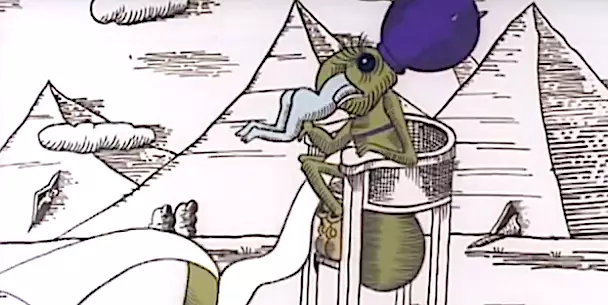
What modern horrors does famed Japanese animator Yōji Kuri invoke in his psychedelic 1972 film “The Midnight Parasites,” above, a surrealist short set in the world of Bosch? Dangerous Minds’ Paul Gallagher describes the plot, such as it is: Here Kuri imagines what would life might be like if we all lived in Bosch’s painting “Garden of Earthly Delights.” It’s a basically shit and death or rather a cycle of life where blue figures live and die; eat shit and shit gold; are skewered, and devoured; are regurgitated and reborn to carry on the cycle once again. Kuri’s satirical vision, in films long favored by countercultural audiences, has “bite,” writes Animation World Network’s Chris Robinson: “he helped lift Japanese animation out of decades of cozy narrative cartoons into a new era of graphic and conceptual experimentation.
His films mock and shock, attacking technology, population expansion, monotony of modern society… Witnessing the surrender of Japan during WW2, the devastation of his country followed by the quick rise of Western inspired materialist culture and rampant consumption, Kuri, like many of his colleagues at the time, questioned the state and direction of his society and world.” His creative appropriation of Bosch, “dark, dirty, oddly beautiful, with a groovy soundtrack,” Gallagher writes, may not, as Meisler worries of many modern takes, get Bosch wrong at all. Though the Dutch artist’s symbolism may never be comprehensible—or anything less than hallucinatory—to us moderns, Kuri’s half-playful reimagining uses Boschian figures for some serious moralizing, showing us a hell world governed by grave lapses and cruelties Bosch could never have imagined. Note: An earlier version of this post appeared on our site in 2018.
Hieronymus Bosch Figurines: Collect Surreal Characters from Bosch’s Paintings & Put Them on Your Bookshelf The Meaning of Hieronymus Bosch’s The Garden of Earthly Delights Explained Hieronymus Bosch’s Medieval Painting The Garden of Earthly Delights Comes to Life in a Gigantic, Modern Animation Hieronymus Bosch’s Medieval Painting, “The Garden of Earthly Delights,” Comes to Life in a Gigantic, Modern Animation Josh Jones is a writer and musician based in Durham, NC. We’re hoping to rely on our loyal readers rather than erratic ads. To support Open Culture’s educational mission, please consider making a donation.
We accept PayPal, Venmo (@openculture), Patreon and Crypto! Please find all options here. Open Culture scours the web for the best educational media.
Extract — continue reading at the source.