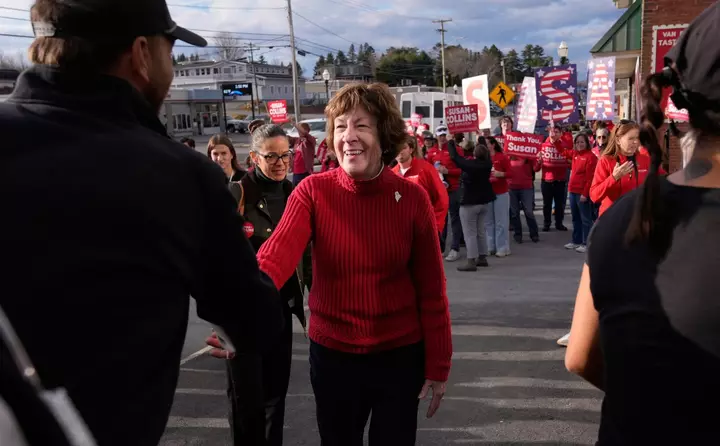
Susan Collins has spent three decades persuading Maine voters to distinguish between a Republican senator and the Republican Party. Once the votes are counted tonight, we may finally learn how far that distinction can stretch. For in Collins, the great quarrels of the 2026 midterms seem to have found a single home.
Trumpism and political independence, abortion and Medicaid, the price of groceries and the war in Gaza: nearly every argument dividing the American electorate has found its way into the political life of one senator from Maine. And almost every one comes down to the same question: where does personal conviction end and party responsibility begin? Her race against Democrat Troy Jackson offers proof that the contradictions both parties are asking voters to resolve can be found in the record of a single politician.
Think about it: Collins has defied Trump, voting to convict him at his second impeachment trial, while also helping advance his agenda by supporting major Republican legislation and confirming many of his nominees. She supports abortion rights but voted to confirm Neil Gorsuch and Brett Kavanaugh, two Supreme Court justices who subsequently voted to overturn Roe v. Wade, arguing at the time that Kavanaugh would respect established precedent.
She opposed Medicaid cuts in Trump's sweeping tax-and-spending legislation, even after voting to advance the bill procedurally, a distinction that allowed debate to proceed without committing her to supporting the final measure. She has delivered concessions on tariffs while her constituents struggle with everyday costs. Pull at almost any thread of the national debate, and, sooner or later, it leads back to Susan Collins.
And at the heart of it all lies perhaps the defining dilemma of American politics in the Trump era: whether a politician can meaningfully separate herself from the party whose power she helps sustain. For Collins, whose political identity has long rested on her independence, the question is particularly consequential. Voters must decide not merely what she believes, but how much those beliefs matter when the consequences of her party's decisions extend far beyond her own votes.
The midterms are, in part, a referendum on Trump. In Maine, that referendum gets a bit complicated as Collins voted to convict Trump after January 6, yet remains a Republican senator whose party controls the White House. At an October debate, Jackson accused her of voting with Trump 96 percent of the time.
Extract — continue reading at the source.