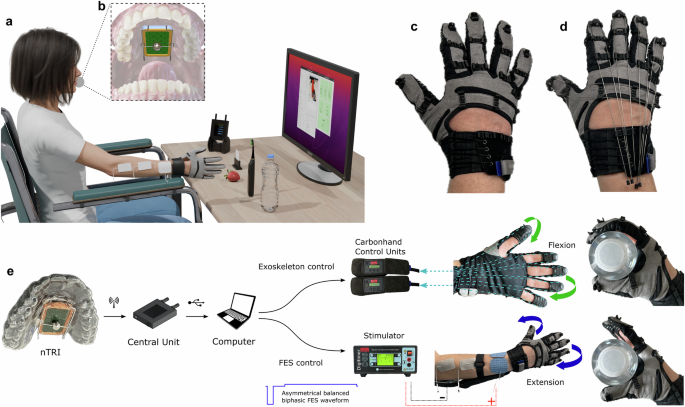
Hand exoskeletons and functional electrical stimulation (FES) have shown promise in restoring hand function after stroke or cervical spinal cord injury. However, major challenges remain in providing reliable user command input in individuals with severe paralysis and in enabling safe and effective control of hand closing and opening. Here, we present a non-invasive tongue-based control strategy for a hybrid soft hand exoskeleton system combining tongue-controlled independent tendon-driven flexion of five fingers with tongue-triggered FES-induced finger extension.
This user-intent-driven hybrid approach supports multiple activities of daily living, such as grasping a bottle or toothbrush, and enables hand opening while mitigating muscle fatigue and reducing system complexity. The system was evaluated in five users with cervical spinal cord injury, demonstrating high task success rates in daily living tasks and user preference due to its wearability and ease of use, as well as consistently low reported levels of discomfort, pain, and fatigue. These findings show that the proposed hybrid system can restore activities of daily living in individuals with cervical tetraplegia, including those with long-term injuries.
Spinal cord injuries (SCI) affect over 20 million people worldwide1, and cervical injuries often result in severe impairment of hand function. Hand function is frequently reported as the most desired motor capability among individuals with paralysis, as it is crucial for quality of life and self-sufficiency2. Accordingly, integrating the human sensory-motor system with rehabilitation robotics has an exceptional potential to restore hand function.
Recent advances have enabled robot movement control through biological signals originating from muscle3,4,5 and brain activity6,7,8. In parallel, developments in hand exoskeleton technology have made grasping possible for individuals with disabilities9,10,11. Other approaches have leveraged functional electrical stimulation (FES) to facilitate hand movements and provide therapeutic benefits12,13,14.
However, key challenges remain in providing reliable non-invasive control input for individuals with severe paralysis, enabling safe and dexterous hand closing and opening while minimizing system complexity, and mitigating FES-induced fatigue. Therefore, addressing these challenges is critical to restore hand function for activities of daily living (ADLs), improve quality of life, and reduce the burden on caregivers15,16,17. For individuals with cervical SCI (tetraplegia), voluntary control inputs are typically limited to body parts above the injury level, often the head and neck, reducing the number of available control commands for interaction with assistive technologies and FES triggering.
Exoskeleton control is possible with user input modalities such as eye tracking18,19, voice commands20,21, brain signals6,7,8,22, or muscle signals3,4,5,23. Additionally, control interfaces for triggering FES can utilize muscle or brain signals and a range of position, pressure, and inertial sensors13,24. Alternatively, tongue-based control interfaces (TCIs) offer reliable command-based input modality due to the availability of robust sensor technologies25,26 and the high flexibility of the tongue27, which typically remains functionally intact even after high-level SCI.
Extract — continue reading at the source.


