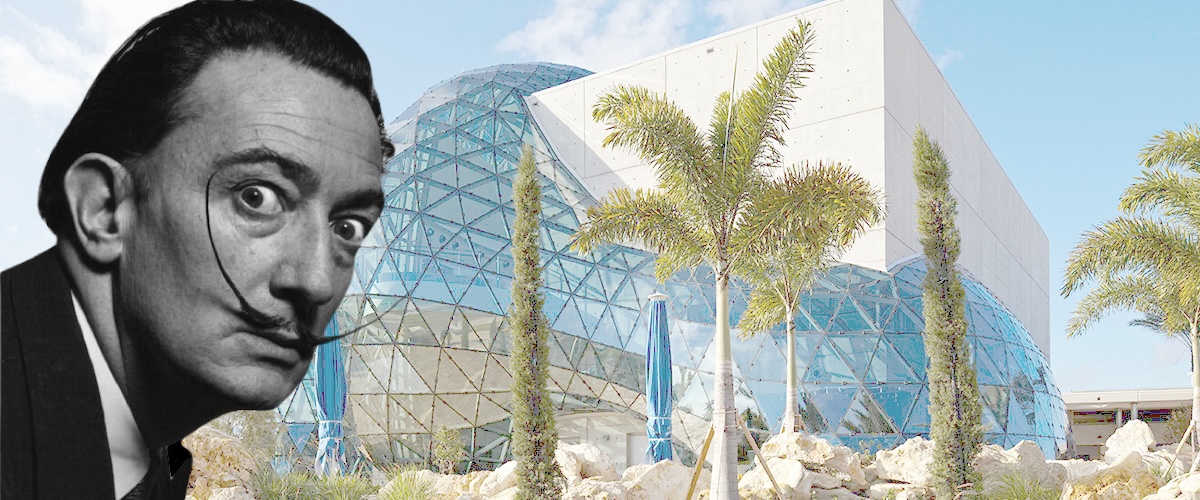
He appears on a life-sized screen, mustache waxed, and talks about his life and his work. He answers questions in his own voice. The museum promises visitors an “opportunity to learn more about Salvador Dalí’s life from the person who knew him best: the artist himself.” Yet, Dalí died in 1989.
Many museums and galleries claim that visitors will “meet” the artist through the work, the idea being that close attention to a work of art leads, inevitably, to an encounter with the person who made it. The Dalí Museum (or “The Dalí,” as it calls itself) has something more literal in mind. In its ongoing exhibition Dalí Lives (via Artificial Intelligence), which opened in 2019, the meeting takes place not through text or image, history or biography, but through a digital reanimation of the man.
There is some sleight of hand in the promise, of course, and not only the obvious kind. Dalí, following a rigorous surrealist method, did not claim to understand his own paintings. The claim that this digital Dalí actually is Dalí is as important as it is strange, and it signals a shift both in what our machines can do and in our relationship to them.
What is it that greets visitors at The Dalí, wearing Dalí’s face and speaking in his voice? The digital Dalí is an application of artificial intelligence, built with the machine learning and digital animation techniques used to make deepfakes and other forms of generative media. When the museum says that “Dalí lives via artificial intelligence,” it means it quite literally.
The system was trained for over a thousand hours on roughly six thousand images and frames of film and other media in order to replicate Dalí’s facial expressions, body movements, speech patterns, and mannerisms. The promotional materials are keen to point out that this is more than a cheap fake, no mere actor or illusion but, in some important way, Dalí. The suggestion is that the algorithms responsible for animating his uncanny likeness have also managed to bring him back from the dead, reassembling him piece by piece.
This is different from other media reanimations of the dead that we have seen in the last few decades. The hologram of Tupac Shakur that performed with Snoop Dogg and Dr. Dre at Coachella in 2012 was a trick of the light, a projected image of a likeness.
Extract — continue reading at the source.