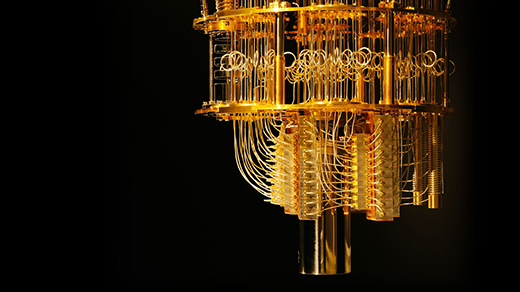
Practically all modern computers, from the cheap microcontroller in your dishwasher to high-tech hardware crunching numbers for artificial intelligence systems, rely on versions of the same technology: slabs of silicon patterned with microscopic structures called transistors. Electronic circuits containing transistors can rapidly and reliably toggle between two states, usually labeled “0” and “1.” That enables them to store and manipulate bits, the basic units of information. Quantum computers have the potential to process information in new and more powerful ways beyond mere 1s and 0s, and to solve certain problems that are too hard for their ordinary “classical” cousins.
But building a machine powerful enough to fulfill that promise remains a formidable challenge. Quantum computing hasn’t yet had its transistor moment, and researchers are still exploring many different approaches to developing quantum hardware. Current approaches differ first and foremost in which physical systems they use as qubits, the elementary building blocks of quantum computers.
Unlike circuits that store classical bits, qubits can exhibit strange phenomena like superposition and entanglement that give them extra computational power. But these quantum effects are also very fragile, easily disrupted by stray interactions between qubits and the surrounding environment. Each proposed qubit technology tries to reconcile two properties that are hard to achieve simultaneously: Qubits must be isolated from outside disturbances, but easy for researchers to manipulate.
Some researchers have placed their bets on natural quantum systems such as atoms. To use a single atom as a qubit, you must first isolate and trap it in a vacuum chamber, and researchers have pursued two distinct approaches to doing so. In trapped-ion quantum computing, researchers knock one electron off each atom to get positively charged ions that can be held in place by electric fields.
The other approach uses arrays of tightly focused laser beams, called optical tweezers, to trap neutral atoms. Other researchers are pursuing an alternative approach, called superconducting quantum computing, which involves the design of artificial qubits. Using modified versions of microfabrication processes developed for classical computing, researchers assemble tiny circuits made of metals like aluminum and niobium that become superconductors when cooled to very low temperatures.
Housed in special cryogenic systems called dilution refrigerators, these superconducting circuits can act like qubits. Many other qubit candidates have been explored, from electron spins to photons to more exotic quantum systems. Scaling up from small prototypes to much larger systems is one of the biggest challenges facing all these approaches.
Extract — continue reading at the source.