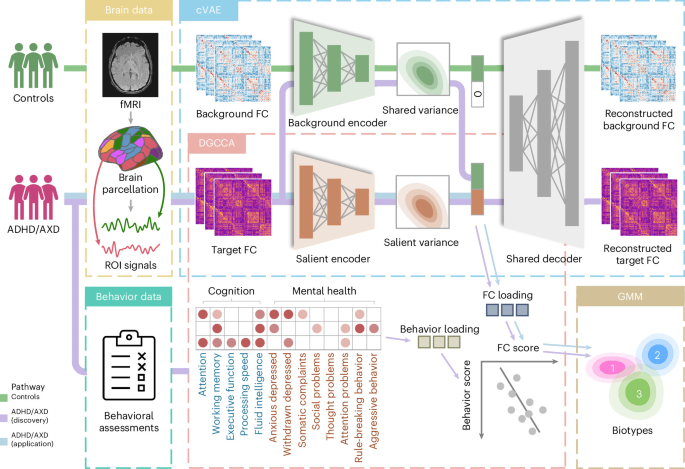
Attention-deficit/hyperactivity disorder and anxiety disorders are highly prevalent in youth and frequently co-occur, yet substantial within- and cross-disorder heterogeneity limits neurobiological specificity and complicates treatment selection. Here we conducted an observational cohort analysis and developed a deep learning framework that integrates clinically salient functional connectivity with cognitive and behavioral measures to identify interpretable transdiagnostic dimensions and biologically grounded biotypes. In 3,508 children aged 9–11 years from the Adolescent Brain Cognitive Development study, the model revealed two reproducible brain–behavior dimensions reflecting cognitive control and emotion–attention regulation.
These dimensions yielded three biotypes (externalizing–disinhibited, internalizing–distressed and mixed dysregulation) with distinct symptom profiles, network organization and brain development. They generalized to 224 age-matched Healthy Brain Network participants and were detectable before symptom onset, indicating preclinical expression. These findings support brain–behavior dimensions for parsing transdiagnostic heterogeneity and motivating early risk stratification and mechanism-informed intervention in youth mental health.
This is a preview of subscription content, access via your institution Receive 12 digital issues and online access to articles Prices may be subject to local taxes which are calculated during checkout ABCD Release 5.1 tabulated data and the ABCD-BIDS Community Collection (ABCC; Collection 3165) are third-party controlled-access data. Access to ABCD data is managed through the NIH Brain Development Cohorts Data Hub (https://nda.nih.gov/abcd/) and is subject to Data Use Certification, required training and NIH security requirements. HBN Release 11 data are available through the Healthy Brain Network Data Portal (https://data.healthybrainnetwork.org/); access to phenotypic data requires completion of a Data Usage Agreement and a LORIS account.
The authors are not permitted to redistribute participant-level data. The DeCoDE framework and demonstration code are publicly available at GitHub via https://github.com/YongJiao10/DeCoDE-BrainBehaviorBiotyping. Model training and hyperparameter optimization used Python 3.14.2, PyTorch 2.10.0, Lightning 2.6.0 and Optuna 4.7.0.
Statistical analyses used SciPy 1.17.0, scikit-learn 1.8.0 and statsmodels 0.14.6; longitudinal mixed-effects models used R 4.3.3. Annual research review: a meta-analysis of the worldwide prevalence of mental disorders in children and adolescents. Psychiatry 56, 345–365 (2015).
American Psychiatric Association. Diagnostic and Statistical Manual of Mental Disorders 5th edn (American Psychiatric Association, 2013). Identification of psychiatric disorder subtypes from functional connectivity patterns in resting-state electroencephalography.
Extract — continue reading at the source.