Dual-task studies consistently find that experts are better at performing two tasks at the same time than non-experts. Usually, this effect is explained by the high degree of skill automatization in experts, given that skills become increasingly automatized during later stages of learning. However, it is not yet clear whether expertise and task automatization following extensive practice exhibit identical or independent mechanisms for reducing dual-task costs.
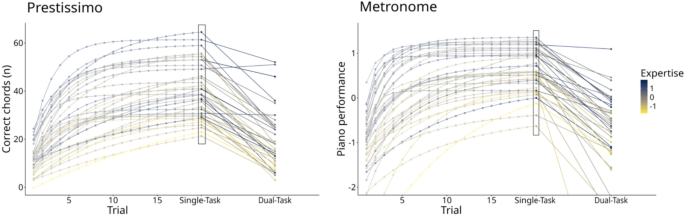
In this study, we investigated how expertise, the learning stage, and higher cognitive abilities contribute to motor–cognitive dual-task interference. Thirty-eight conservatory-level pianists practiced two novel piano sequences. Each sequence involved the same practice time for all participants (i.e., 20 trials) for which individual learning rates—proxies of the learning stages by the 20th trial—were computed.
Subsequently, they performed the sequences either at maximal speed or to a fixed metronome tempo while concurrently solving a mental arithmetic task (counting in steps of 7). Using Bayesian hierarchical modeling, dual-task costs were estimated as the change in piano performance between single- and dual-task performances while statistically controlling for cognitive dual-task costs. Results showed that higher piano expertise and later learning stages robustly reduced dual-task costs.
Further, higher piano single-task performance, successful memorization of the piano sequence and better cognitive abilities, such as processing speed and switching ability, were also found to reduce dual-task costs. Finally, mediation analyses indicated that expertise and task automatization had largely independent effects on dual-task costs, suggesting distinct mechanisms. Therefore, future studies should avoid equating task automatization with expertise when interpreting dual-task costs.
Institute of Music Physiology and Musicians’ Medicine, Hanover University of Music, Drama and Media, Hanover, Germany Florian Worschech, Hannah Losch & André Lee Institute of Psychology, German Sport University Cologne, Cologne, Germany Center for Systems Neuroscience, Hanover, Germany Institute for Music Education Research, Hanover University of Music, Drama and Media, Hanover, Germany Department of Neurology, University Hospital rechts der Isar, TUM School of Medicine and Health, Technical University of Munich, Munich, Germany All authors declare no financial or non-financial competing interests. The study was conducted in accordance with the Declaration of Helsinki, and the protocol was approved by the Central Ethics Committee at Leibniz University Hannover (Project identification code: EV LUH 15/2023; approval date: 23-11-2023). Springer Nature remains neutral with regard to jurisdictional claims in published maps and institutional affiliations.
Open Access This article is licensed under a Creative Commons Attribution 4.0 International License, which permits use, sharing, adaptation, distribution and reproduction in any medium or format, as long as you give appropriate credit to the original author(s) and the source, provide a link to the Creative Commons licence, and indicate if changes were made. The images or other third party material in this article are included in the article’s Creative Commons licence, unless indicated otherwise in a credit line to the material. If material is not included in the article’s Creative Commons licence and your intended use is not permitted by statutory regulation or exceeds the permitted use, you will need to obtain permission directly from the copyright holder.
Extract — continue reading at the source.