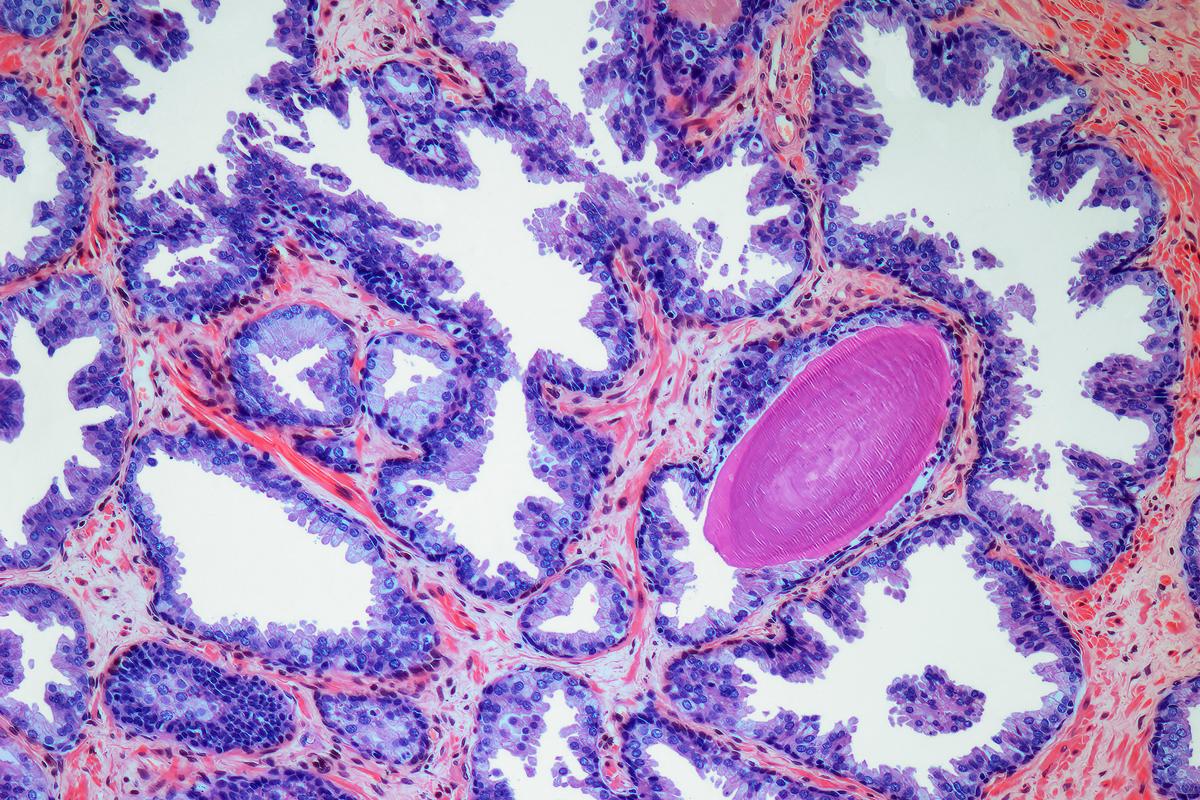
Light micrograph of a section through a prostate gland with benign prostatic hyperplasia. Photo by Steve Gschmeissner/SPL William came to me for a third opinion. He was 53 and healthy, with a wife and two teenage children, a busy job, and a typically hectic work-and-family schedule.
He’d taken time to do the right thing and had visited his primary care provider for a routine health exam and blood tests, his first in many years. A few weeks later, he’d found himself in an unfamiliar urologist’s office, at the edge of an abyss, ears ringing with what may be three of the most dreaded words in medicine: ‘You have cancer.’ This diagnosis portends pain, suffering and death: in the United States alone, cancer kills more than 600,000 people a year, enough lives to empty a city. Yet, receiving a cancer diagnosis doesn’t necessarily mean what it once did.
William was in very broad company: more than 2 million Americans a year receive the diagnosis and, for many, the finding entails little to no threat to length or quality of life, except through the ill effects of treatments. However, patients labelled with the ‘C-word’ face substantial clinical, psychological, social and economic consequences. This disconnect – between what the word evokes in my exam room and what it often describes in contemporary practice – drives controversies and variability in screening practices, and in light of our growing understanding of cellular biology, demands that we rethink what we really mean when we apply the label ‘cancer’.
William’s cancer was in his prostate, an organ of whose existence he was previously only vaguely aware, but whose removal or radiation risked impairments to urinary, bowel and sexual function. His biopsy had revealed a prostate tumour we designate ‘grade group 1’, which features few molecular hallmarks of cancer and no immediate potential for metastasis or death. Nonetheless, beset with many competing opinions from his rapidly expanding medical team, William found himself rushing headlong toward treatment, and wrestling with a constant anxiety he’d never felt before.
By the time he reached my office, he had taken medical leave from work and confided that, perversely, he was smoking for the first time in decades. When I started medical school in the 1990s, I found cancer fascinating and terrifying exactly because of the betrayal it represented. Most human disease represents failure of one body system or another.
Whether due to trauma, infection, degradation of blood supply, mechanical wear-and-tear or other causes, one or more organs stop performing optimally. In such cases, our job in medicine is simple in principle: support the failing system, prevent further damage, and repair or replace missing function as much as possible. Cancer is fundamentally different: although ultimately it also causes system failures, its origin lies in cells in a corner of a given organ thriving more than they should, growing too quickly, and eventually exploring and colonising other parts of the body.
Extract — continue reading at the source.