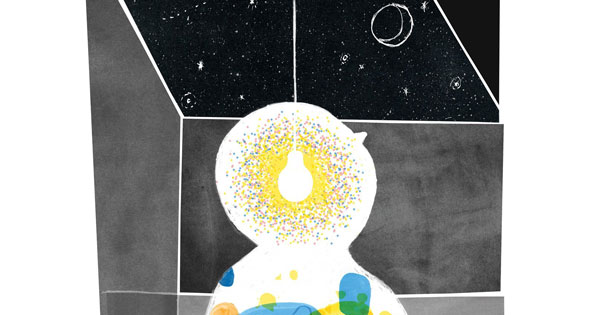
Few things in life are more vivifying than a shimmering reminder that we can still surprise ourselves — those rare moments when the urn of the self cracks and out pours something more fully alive: truer than any narrative, more authentic than any performative personhood, unfettered from identity and expectation and all the other scripts we live by. It is both thrilling and terrifying to be so reminded that we know ourselves only incompletely and the future not at all; that inside us dwell parts so unexplored as to be capable of surprising the conscious totality — parts drawing on some subterranean river of lore to make instantaneous decisions we never could have planned and did not anticipate. Lurking in it all is the haunting intimation of the illusion of choice, gnawing at the fundament of the self: Who exactly is doing the deciding that surprises the decided-for?
And yet out of such confusion, such delight. We call these delightful and disorienting deviations from the script improvisation. Nowhere are they more impressive, or more illustrative of the broader paradoxes of the self, than in music.
That is what violinist Natalie Hodges explores in one of the most enchanting parts of Uncommon Measure: A Journey Through Music, Performance, and the Science of Time (public library) — her altogether fascinating inquiry into the poetic science of sound and feeling. In improvisation, the generation of material is spontaneous, but it’s never random. This in itself constitutes a paradox: If you can choose to play anything, with equal probability, what could make you choose any one thing — on the spur of the moment, blindly, trusting, without thinking about it — except chance?
In other words, how can the spontaneous be anything but random; how can music made in a jolt of instinct, on a bolt out of the now, be endowed with a form that makes sense in time, as though it had been written and rewritten and practiced and memorized beforehand? And how, in making that first, most instinctive, most desperate decision, do we choose — if it really can be called “choosing,” if we really choose at all? For all this perplexity, there is something incredibly liberating in improvisation — a sort of “unselfing,” to borrow Iris Murdoch’s perennially lovely term; something that provides, as Hodges puts it, “the feeling of easy self-suspension that in the best moments can accompany deep focus, the way that when you have to throw yourself into a task it becomes almost a way to abandon the self, almost a relief to leave the self behind.” She takes these questions to a Radcliffe lecture titled “What Choice Do I Have?” by the virtuosic Venezuelan pianist Gabriela Montero, who has stunned millions with her astonishing improvisations on musical prompts given to her by the audience.
Out of a tiny seed handed by a stranger, a striking original composition comes abloom in real time, with no premeditation and no practice — a skill so natural to Montero yet so seemingly otherworldly that her brain became the subject of an fMRI study, the findings of which affirm physicist and jazz saxophonist Stephon Alexander’s insistence that “it is less about music being scientific and more about the universe being musical.” To discern the neural correlates of improvisation, scientists observed Montero’s brain under three conditions: playing scales, the most prescriptive of all musical structures; playing a memorized Bach piece; and improvising from an initial Bach prompt. They found that the Default Mode Network — the same brain region which time in nature unlooses to make us more creative and which psychedelics shake up — lit up in an entirely different way when she improvised rather than playing from memory. Improvisation, in other words, is our built-in remix rotor of consciousness. [The Default Mode Network is] a sprawling system of functional connectivity between regions of the brain that, loosely put, modulates the many facets of the self.
These include, to name a few, the medial prefrontal cortex, which controls decision-making, self-perception, and autobiographical memory; the hippocampus, which forms new memories; the angular gyrus, a center of perception and spatial cognition, a sense of oneself in the physical world; and the dorsal medial prefrontal cortex, responsible for thoughts about others and their relation to the self. During the scale and memory trials, these areas of Montero’s brain lit up with interconnectivity, as though her senses of time and space and memory were all talking to one another, working together to re-create these tasks that, together, they had been preprogrammed to execute. But each time the researchers asked Montero to switch to improvisation, the light of that interconnectivity was suddenly, substantially dimmed. (In more technical terms, the interactions between those various regions were significantly and quantifiably reduced.) If the regions of the DMN, working together, represent a unified sense of self, upon which Montero draws when she is playing music she has learned in the past, the act of improvisation somehow disbands that cohesion, requires her to draw on something else.
Extract — continue reading at the source.