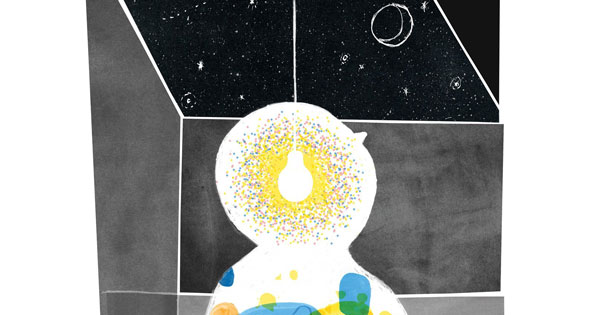
Each time you look up at the night sky, you see only ancient signals — by the time a photon has reached your pupil, the star that emitted it may be long dead. The great wonder is that its light can traverse immense expanses of space and time to gladden the darkness of today, to cast wonder upon this lonely planet. An idea is a signal that may travel across immense expanses of space and time before it touches the world.
Transformative ideas can and often do fall on the closed eyes of their epoch. But, over and over, history hands us the glad assurance that it can take just one person awake enough to receive the signal so that others can then see it, to interpret it so that others can appreciate its singularity, its significance, its beauty. (See, for instance, Fanny Wright and atomism, Girolamo Mercuriale and fitness.) Like a star, a good idea has a gravitational pull that attracts other bodies into its obit. Unlike a star, which invariably runs out of hydrogen fuel and dies, an idea cannot be unthought — once it exists, it is forever lodged in the collective conscience, however deep the recess.
Some of humanity’s best ideas come from galaxies of thought so remote from the status quo that their light can take generations or civilizations to touch the world, the faint signal magnified and reflected by a handful of believers like a relay of mirrors across the dark sky of time until it becomes a beacon. That is what David Byrne chronicles in Sleeping Beauties: Why Good Ideas Go Dormant and How They Wake Up (public library) — a book masted with passion and ruddered with rigor, celebrating the lost history of creativity through the stories of the forgotten, neglected, and erased visionaries who from the margins of their time wrote the history of the future. David — one of the most indiscriminately and ardently curious people I know, whose contagious enthusiasms will enchant you with everything from the geometry of trees to the dream culture of Malaysian tribal groups to the mating habits of eels — selects discoveries, inventions, and creations that traverse the vast spectrum of human ingenuity: from painting to astronomy, from music to microbiology, from literature to civil engineering.
Some have only recently bubbled to public awareness (Vera Rubin and dark matter, Lynn Margulis and symbiotic life), some are unknown to most, perhaps precisely because they have become so plainly embedded in our model of the world, the model they helped build (Marie Tharp and plate tectonics, Peter Kropotkin and mutualism, the invention of hand-washing), some have transformed our lives in a very practical way (cement, perspective, inoculation), some in a spiritual way (the paintings of Caravaggio and Beauford Delaney, the writings of Melville, the music of Bach), and some have simply dusted our lives with delight (the wonders of lichen). Reflecting on how such transformative ideas can go dormant for decades (solar panels), centuries (irrigation systems in South India), or millennia (the atom), David observes: We’ve evolved to rely on whatever assumptions, models, and perception work for us — or at least work most of the time. If it’s right most of the time, or for the time being, then that’s held as proof that our assumptions must be valid and true, and we will be successful.
Our faith in our assumptions often temporarily increases our odds of survival and success, until it doesn’t, until the curtain is pulled away and our assumptions are revealed to be just that, assumptions, not grounded in fact or reality. One of our most reflexive and most limiting assumptions is that we are the pinnacle of creative and intellectual development, the past too distant and dumb to offer any ideas better than our own: Our tendency as humans is often to imagine that the “story” of history leads us to where we are right now. We like to imagine ourselves as some sort of inevitable culmination — it all led to us.
What we see, and what we judge as important and significant, viewed in the rearview mirror is determined by how we see ourselves at present. Undermining the hubris of our own inevitability is the ease with which anything could dislodge us from our chosen course in a blink. An accident is simply our term for a moment in which chance intercedes into our lives to remind us that we are not in control, to remind us that all of our plans and predictions are just provisional models of the possible, which will always exceed our imagination because we ourselves are figments of the improbable.
Extract — continue reading at the source.