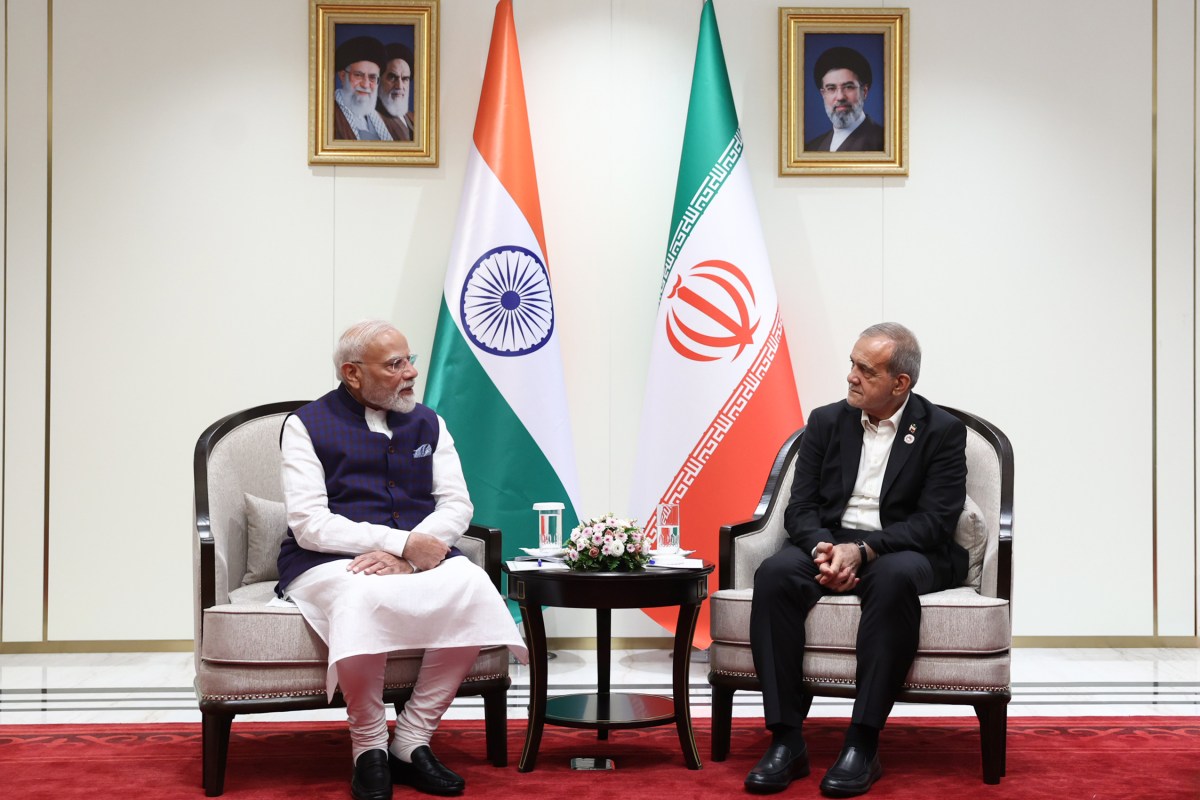
As Iran seeks to combat the United States' efforts to isolate the Islamic Republic in the midst of their six-month war, Iranian President Masoud Pezeshkian has issued an appeal to an influential head of state who has often received praise from President Donald Trump. Pezeshkian used the Shanghai Cooperation Organization summit in the Kyrgyz capital of Bishkek to meet Monday with Indian Prime Minister Narendra Modi, who has long sought to balance New Delhi's foreign policy amid international and regional rivalries. The meeting, which came the same day as Trump threatened to hit Iran "hard" over recent strikes targeting an American base in Jordan, saw Modi hear out the Iranian case for opposing the conflict.
Rajeev Agrawal, a retired Indian Army colonel who is now a senior research consultant at the Chintan Research Foundation, described the encounter as "very significant" for two main reasons. "One, it is the first face-to-face meeting between them ever since the Iran war started on 28 February, although they have spoken on phone a number of times," Agrawal told Newsweek. "Secondly, Iran considers India a very influential voice in the global arena and so whatever President Pezeshkian said to PM Modi, gets global attention straightaway." Agrawal pointed two particular statements from Pezeshkian that stood out, the first being the Iranian president's assertion that, despite Iran seeking peace, the "Americans have chosen the path of war, insecurity and imposing their will through force," and the second being that "the American side has failed to fulfill its commitments" to the memorandum of understanding signed by Pezeshkian and Trump on June 17.
Both comments, Agrawal argued, "give Iran an excellent platform with the Indian PM in listening to deliver a message to the world." And in addition, Agrawal said, "by stating, 'Despite the pressures and restrictions being imposed in an attempt to obstruct Iran’s relations with other countries, Tehran is ready to expand its cooperation with India across various fields,' he sought strong support from India." Modi's office said the Indian leader discussed "ways to further strengthen India's friendship with Iran" and "reiterated the need for continued efforts to ensure lasting peace and stability in the region." At the same time, he called for "safeguarding the freedom of navigation and commerce" and "emphasized that civilians and civilian infrastructure, including commercial shipping and seafarers must not be harmed under any circumstances." Since the beginning of the conflict, Iran has targeted ships and infrastructure across the Persian Gulf region as a means of putting pressure on the U.S. and its partners by raising the costs of the war. India has condemned this practice, including the Iranian strike on a vessel last month that killed an Indian sailor near the Strait of Hormuz. At the same time, India has consistently called for a ceasefire rather than escalation, having criticized the U.S. for a strike that killed over 100 Iranian sailors on a ship that had just completed joint exercises with the Indian Navy in March.
Channeling India's global influence and calls for peace, Pezeshkian's office said he asked Modi "to use the capacity of his contacts with various parties to help them return from the path of war and bloodshed to the path of dialogue and agreement." The meeting venue is also significant. Since its establishment in 2001 from the initial Shanghai Five bloc formed five years earlier, the SCO has emerged as a growing hub of multilateral cooperation outside Western frameworks. Originally consisting of China, Russia and the Central Asian countries of Kazakhstan, Kyrgyzstan, Tajikistan and Uzbekistan, the SCO was expanded to include both India and Pakistan in 2017, followed by Iran in 2023 and Belarus in 2024.
It also includes one active observer member, Mongolia, and 15 dialogue partners, including Armenia, Azerbaijan, Bahrain, Cambodia, Egypt, Kuwait, Laos, the Maldives, Myanmar, Nepal, Qatar, Saudi Arabia, Sri Lanka, Turkey and the United Arab Emirates. The SCO's stated mission includes shoring up political, economic and security ties, with a particular focus on counterterrorism. However, it does not constitute a security alliance or mutual defense pact like the U.S.-led NATO or Russia-led CSTO.
Despite unlikely granting any overt aid to Tehran, Agrawal said that the SCO "offers Iran the best multilateral platform to share its views and also garner 'non-West' support." "The SCO Summit may not deliver anything tangible for Iran, but the optics may worry the U.S. quite a bit, especially if the Operation Economic Outcast does not deliver on its objectives, primarily due to support from many countries in the SCO grouping," he said. Ali Ahmadi, an executive fellow at the Geneva Centre for Security Policy and fellow at the Middle East Institute Switzerland, said that from Iran's perspective, "it is important to be realistic about the fact that SCO is not, and never will be, an Asian NATO," particularly as members predominantly approach security issues individually rather than as a collective. At the same time, he said that the SCO remains "a valuable coordination body on both economic and military issues," and that "Iran's membership in these institutions does limit its isolation build hope that it can play a greater role in an emerging world order." Iran-SCO ties become even more crucial as Tehran pivots toward greater reliance on overland trade routes amid a U.S. maritime blockade.
Extract — continue reading at the source.