Recently, President Donald Trump banned three media organizations from the White House because of their negative coverage of him and his administration. Like Trump, Hitler was not on the ballot. Like Trump, Hitler saw the March 5 election as a referendum on his administration.
Like Trump, Hitler was polling 33 percent nationally, virtually identical to ’s most recent approval rating for the president. And like Trump, Hitler turned to the courts when he did not like election outcomes. Amidst all the turmoil, everyone understood that the March 5 election was a make-or-break moment not only for the Hitler chancellorship but for democracy itself.
Before his appointment as chancellor, Hitler had run for the position of Reich president against the incumbent, Paul von Hindenburg. When Hindenburg crushed Hitler at the polls, in spring 1932, Hitler sought to have the results overturned amid claims of voter fraud with mail-in ballots and irregularities by state officials. The judge dismissed the case out of hand, claiming that Hitler’s six million vote loss to Hindenburg, out of the roughly 36.8 million votes cast, was too great a margin for error.
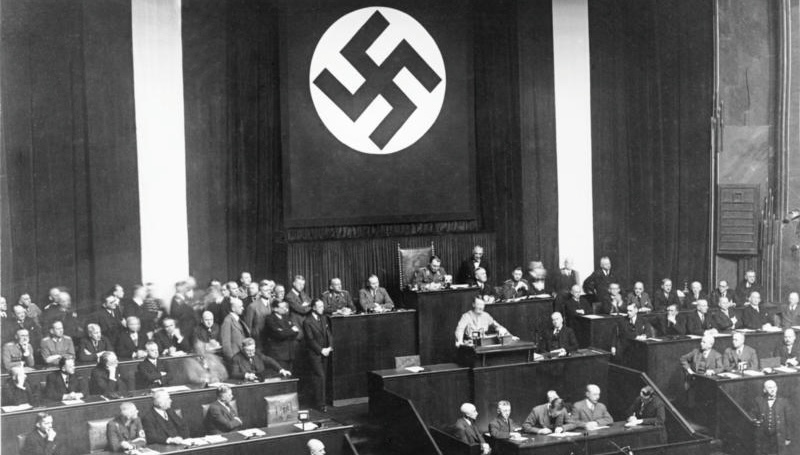
Hitler was subsequently appointed chancellor by Hindenburg, in January 1933, after his party secured in the 1932 legislative elections a relative majority in the 600-seat Reichstag, Germany’s parliament. Hindenburg agreed to dissolve the Reichstag, at Hitler’s urging, and schedule new elections, for March 5, 1933. Hitler intended the legislative elections as a populist referendum on his government, after having been assured by his Gauleiter, his local political operatives, that the national socialists would easily clear 51 percent in elections, allowing Hitler to rule without the constraints and compromises of a coalition government.
Hitler leveraged his executive powers to tilt the elections. An emergency decree, signed by Hitler and Hindenburg, restricted press freedoms and public demonstrations. Newspapers took the government to court to have the bans overturned.
Hitler tried to rewrite election laws. He considered mobilizing the army to maintain public order only to be told by his defense minister, in no uncertain terms, that it was unthinkable that a German soldiers would be ordered to shoot at on German citizens in the streets of German cities. Hitler was even suspected of engineering a pre-election surprise.
Extract — continue reading at the source.