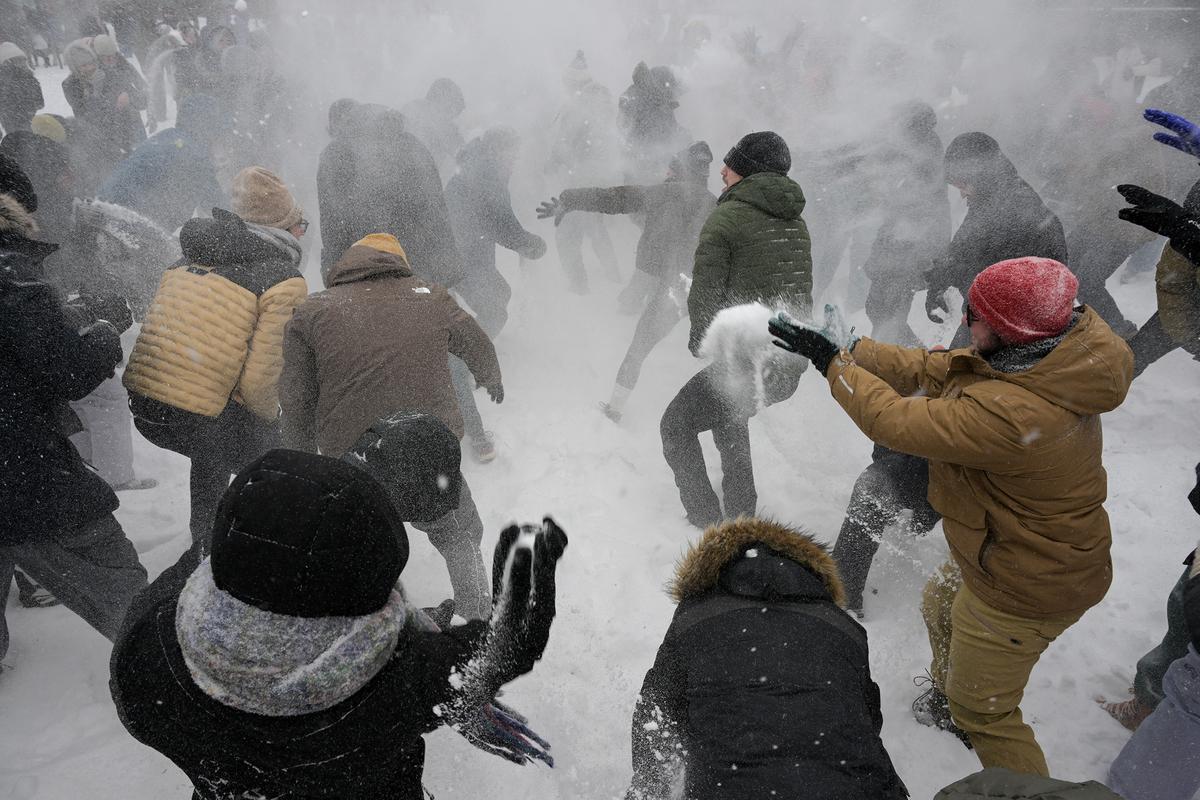
A mass snowball fight in Meridian Hill Park in Washington, DC, on 25 January 2026. Photo by Oliver Contreras/AFP/Getty Images Our kids were playing Settlers of Catan over the holidays. They’d rearranged the strategy game’s hexagonal tiles into an archipelago of islands that no rulebook recognises, imagined ‘bridges’ built from wood, brick and stone, and invented a purpose for the game about network connectivity that had nothing to do with earning points.
They were not playing Catan. They were playing in Catan, using its materials as components to make a world the designers never imagined. My first instinct was to reach for the rulebook and teach them how the game actually works.
My next was to figure out how I could win. It took me a while to realise what I really needed to do: build up the courage to ask if I could sit in and build with them. That was the moment something shifted – not for the kids, who were already there, but for me: a 48-year-old professor sitting on the carpet, making islands and building bridges without a point in sight.
You can play a game or you can play in a game. When you follow the official rules, pursue the stated objective, and measure yourself against opponents or a scoring system, that’s competition: playing a game. The Greeks had a word for this kind of play: agôn, from the god who personified conflict, struggle and contest.
But when my kids disassembled the board and turned it into a world, they were doing something older and stranger. They were engaged in what the French sociologist Roger Caillois, in his taxonomy Man, Play and Games (1958), called paidia: free, spontaneous, unstructured play. The kind with no winner, no score, and no optimisation.
The kind of play that has almost no place in adult life and, arguably, the kind we need the most, especially now, when even our leisure comes with leaderboards. The entire architecture of digital life – with its algorithmic feeds, frictionless production and the ambient expectation that we should be consuming or optimising at all times – nudges us towards chasing outputs rather than generating meaning. We track our sleep and score our calm.
Extract — continue reading at the source.