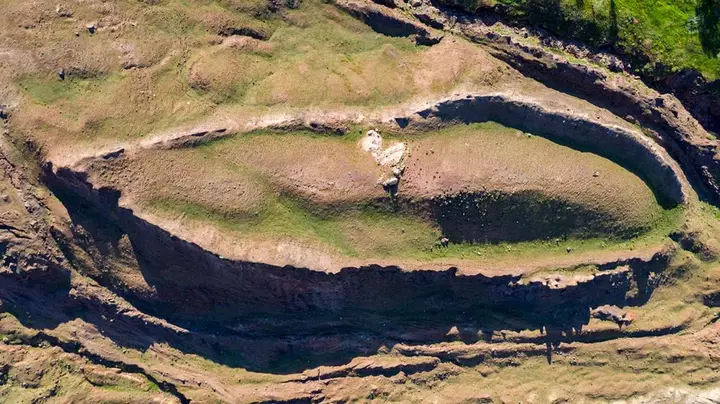
A team searching for the remains of Noah’s Ark in a boat-shaped rock formation in Turkey has revealed footage from what could be the "hull" of the vessel. The U.S.-based group Noah’s Ark Scans has repeatedly said it believes its expedition at the famous Durupınar Formation will eventually provide evidence that the biblical ship is buried there. On Monday, the group posted a video of "never-before-seen footage inside the voids near (what we believe to be) the hull of Noah’s Ark." It said the team chose to drill into the area after preliminary scans showed what could be a "possible outer shell" of the ship trapping water there, which the group hopes to determine by proving it is made up of different materials than the ground on either side of it.
The researchers plan to test soil in the area "at various depths to analyze its composition," Noah’s Ark Scans founder Andrew Jones told Newsweek. The boat-shaped Durupınar Formation has long attracted people hoping to find Noah’s Ark. It lies south of Mount Ararat in eastern Turkey, a region referenced in the biblical account of the Ark.
Genesis (8:4) says that, as floodwaters receded, "the ark came to rest on the mountains of Ararat." But multiple studies have concluded that the ship is not there. The most famous one was carried out in 1996, which included a researcher who started the project believing he may find the ark. However, he ultimately determined that the Durupınar Formation had been "misidentified" and is actually "a completely natural rock formation." Noah's Ark Scans is trying to disprove this.
The group hopes that samples it collected when it started drilling in September will turn out to be wood. Jones has said this will "challenge claims that this is simply a natural shape made of limestone or bedrock." The group has published a preliminary report based on its scans, but this has not yet been peer-reviewed. The team has not yet identified any wood material, with lab test results still pending.
Newsweek has not reviewed its scans and cannot independently verify the team’s interpretation. A final report on Noah’s Ark Scans’ findings is expected in late April or May next year, Jones said. In the caption shared with the video, Noah’s Ark Scans said scans of the location had shown a "clear outline of a hull made of different material than the mud around it." The group said there was "a distinct band following the boat’s outline" that "appeared different from the ground on either side of it." The team had interpreted this as "a possible outer shell, with mud inside and outside—the kind of pattern they said could fit a wooden boat buried in mud." Noah’s Ark Scans said it would use information from its drilling to compare with its earlier scans.
"We still need to determine what that outer layer is actually made of, and what’s keeping the water in there," it added. Water can collect underground naturally—the U.S. Geological Survey says that groundwater separated from a larger body of water is "typically is isolated from the regional water table by low-permeability beds" (layers of rock that water cannot easily pass through).
Extract — continue reading at the source.