Yemeni students in Saudi universities occupy an unusual position. They study abroad, yet in a country that shares their language, religion, and much of their culture, while their families remain in a state that has been at war since 2014. Depression and anxiety are common among international students generally, and recent national data from Yemen show that almost half of Yemeni medical students screen positive for depressive symptoms.
What happens to this group once they cross the border into Saudi Arabia has not been described. This study examined the burden of depressive and anxiety symptoms among Yemeni students in Saudi universities, together with the demographic characteristics and levels of perceived social support associated with symptom severity. We conducted a cross-sectional online survey of 137 Yemeni students enrolled at Saudi universities, reported in accordance with the STROBE statement for cross-sectional studies.
The questionnaire was offered in Arabic and English and comprised the Patient Health Questionnaire-9 (PHQ-9), the Generalized Anxiety Disorder-7 scale (GAD-7), and the Multidimensional Scale of Perceived Social Support (MSPSS). Internal consistency in the present sample was good to excellent (Cronbach alpha 0.84 for the PHQ-9, 0.89 for the GAD-7, and 0.94 for the MSPSS). Crude and adjusted linear regression models were fitted in SPSS.
Recruitment was by convenience sampling through student networks and social media, so the analysis is framed as exploratory throughout. Participants were predominantly male (122 of 137, 89.1%) and older than 24 years (95 of 137, 69.3%). Mean PHQ-9 and GAD-7 scores were 8.7 (SD 4.79) and 6.2 (SD 4.51).
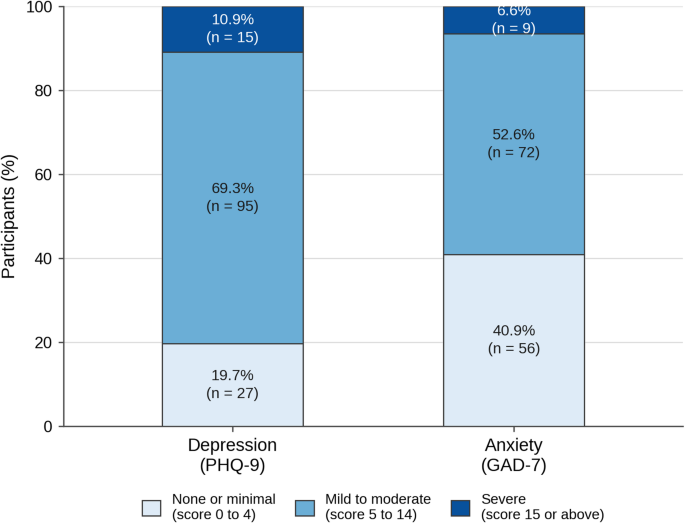
At the conventional cutoff of 10 or above, 37.2% screened positive for depressive symptoms and 19.0% for anxiety symptoms. Mild to moderate symptoms were reported by 69.3% of participants for depression and 52.6% for anxiety. In models adjusted for age, gender, marital status, family residence, family income, and social support (n = 134), postgraduate enrollment was associated with higher depression (b = 2.381, SE 1.117, p = 0.035) and anxiety scores (b = 2.243, SE 1.073, p = 0.039), and perceived social support was inversely associated with both outcomes (depression b = -0.111, SE 0.023; anxiety b = -0.091, SE 0.022; both p
Extract — continue reading at the source.


