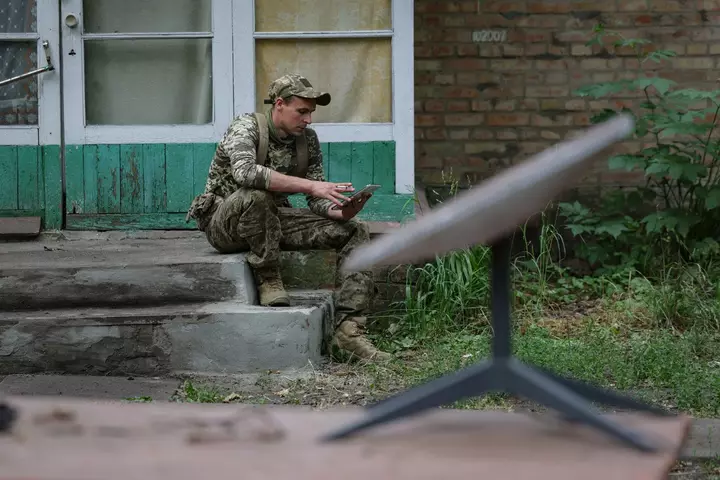
It was roughly 6 a.m. on Wednesday morning when Yehor, a Ukrainian soldier deployed near the battered northeastern city of Kupiansk, noticed the military-grade version of Starlink wasn't working properly on a drone he was piloting. His unit suddenly lost touch with the explosives-laden drone, which was already flying toward a Russian logistics site Ukraine had decided to target, he told Newsweek. The drone automatically reduced its speed in the skies above Ukraine's Kharkiv region, and the troops managed to claw back their connection.
But it was for naught; they had missed their chance to reach their target in time, while the drone's battery was quickly depleted by the longer journey it was forced to make at a slower speed. It emerged later on Wednesday that Starshield—Starlink's more secure sister satellite internet provider—was capped at a maximum speed of 160 kilometers per hour (100 mph), meaning the maximum speed for some of Ukraine's most-used drones was slashed in half. Russia's defenses then have more warning for incoming threats and can more easily shoot them down.
Both Starshield and Starlink are a creation of Elon Musk's SpaceX firm, and Ukrainian troops have relied on the thousands of satellites sitting in low-Earth orbit to fend off Russia's full-scale invasion since the early battles more than four and a half years ago. Newsweek has contacted SpaceX and the White House via email. Ukraine's Ukrinform state news agency reported on Thursday Starshield was back up and running as normal.
But Dimko Zhluktenko, a junior sergeant with Ukraine's 413th Unmanned Systems Regiment, told Newsweek that although Starshield-enabled drones are now able to fly faster than on Wednesday—when they flew at speeds around 90 kilometers per hour, according to Dimko—they are still limited to 160 kilometers per hour. There was no previous limit to Starshield in Ukraine. But the incident highlights how vulnerable Ukraine's operations are to U.S. whims, with no viable alternative yet to Musk's orbiting constellation.
Without the access to Starshield Ukraine is used to, Kyiv has trouble making sure its aerial and sea drones can travel fast enough to hit Russian logistics, munitions depots as well as command and control centers up to around 200 kilometers (nearly 125 miles) from front-line clashes when buffeted by jammers. It also hampers Ukraine's ability to intercept Russia's newer—and quicker—jet-powered, Iranian-designed Shahed drones as they bear down on its major cities, at a moment when Ukraine has celebrated reclaiming territory around the strategic eastern city of Lyman. Starlink and Starshield are "baked into how the armed forces work," said James Westlake, the head of the U.K. team for Ukrainian intelligence firm, Molfar.
They are "integral," he told Newsweek. Ukrainian forces mostly use the general Starlink network for communications and data transfers, rather than guiding strikes on the battlefield, Westlake said. The speed Ukraine can use for Starlink has long been capped and doesn't appear to have been impacted this week.
Extract — continue reading at the source.