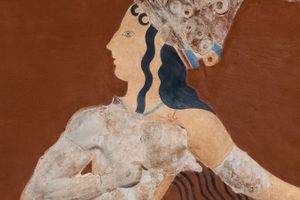
It's usually presented as a king, sometimes a priest-king, ruling from Knossos around 1500 BCE. The problem is that almost none of that figure actually survived. Excavated in fragments by Arthur Evans' team in the early 1900s, the fresco was heavily reconstructed, and controversially so: the original pieces show a torso, a crown, and separate body fragments that may not even belong to the same figure.
Evans' restorer, Émile Gilliéron, combined them into a single striding male figure, filling enormous gaps with guesswork and plaster. Later scholars have proposed the crown and torso might belong to two, even three, different people, possibly including a female boxer or a sphinx-like composite creature, rather than one princely man at all. The debate cuts to the heart of a broader criticism of Evans' work at Knossos: his reconstructions, done in concrete and paint, are often described less as restoration than as invention, projecting a coherent, palace-and-king narrative onto a civilization whose actual social structure remains poorly understood.
Get more unusual and extraordinary places each week with the Atlas Obscura Places newsletter. Your newsletter subscriptions with us are subject to Atlas Obscura's Privacy Policy and Terms of Use. From open waters to open dance floors—this decommissioned ferry has been transformed into a lively nightclub.
A Roman mosaic depicting a classical myth was only rediscovered after bombing during World War II. Red ocher pictographs survive in this tufa rock shelter on the shore of an ancient lake. A former military hospital is now used to study and preserve artifacts of the Acropolis.
View the ancient remains of buildings and the ancient "River of Hades" before hopping on a train. Two of the few remaining life-sized Greek bronzes were submerged in the sea for over 2,000 years. According to one local legend, this image was created during a battle between a wild lioness and the archangel Michael.
A winery built on the site of a Gallo-Roman estate uses historical tools to recreate ancient vintages. ## Become an Atlas Obscura Member * * * Join our community of curious explorers. Become a Member Atlas Obscura uses cookies on its websites to personalize content and ads, to provide social media features, and to analyze our traffic.View Cookie Policy When you visit any website, it may store or retrieve information on your browser, mostly in the form of cookies. This information might be about you, your preferences, or your device, and is mostly used to make the site work as you expect.
Extract — continue reading at the source.