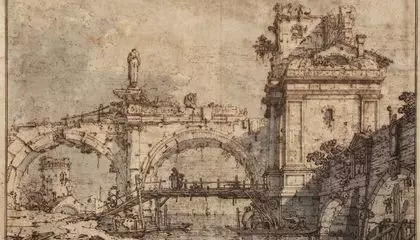
A previously unknown drawing by the 18th-century Venetian artist Canaletto is heading to auction in England. The pencil and brown ink sketch—only just authenticated—is one of Canaletto’s famous capricci, imaginative art works that blend detailed studies of real architecture into fantastical scenarios. It was authenticated by Charles Beddington, an art dealer, historian and Canaletto expert.
Canaletto likely composed this scene between 1746 and 1755, during his stint in England, as a sketch for a painting that was later auctioned by Christie’s in the 1990s. Born in Venice in 1697, Giovanni Antonio Canal, more commonly known as Canaletto, was a vedutisto, or “view painter.” He became famous for highly detailed depictions of his hometown. In fact, Canaletto’s cityscapes were so accurate that he was once accused by a biographer of tracing buildings with a camera obscura. (Researchers disproved this rumor with the help of infrared technology in 2017.) The recently authenticated drawing depicts a ruined Renaissance-era arcade with two crumbling arches spanning a canal.
Before them is a rickety wooden footbridge. Embedded in the riverbank silt is old debris, including a stray carriage wheel. Harsh light and shadow add depth to the scene, and everyday characters are scattered throughout.
These artworks depict fabricated scenes amid real structures, such as columns from the Roman Forum or Venetian archways. Capricci became popular among Italian artists during the Baroque period, with practitioners including Francesco Guardi and Giovanni Paolo Panini. While Canaletto’s fame is today associated with his more straightforward cityscape views—one such painting of Venice sold for $30.5 million earlier this year—“the painter himself may well have been more proud of his capricci, works of the imagination being held in higher esteem, particularly by his Italian contemporaries,” per Mallams.
A Canaletto painting called The Stonemason’s Yard, circa 1725, spent four years stashed in a Welsh slate mine during World War II to keep it safe from German attacks. An inscription on the back of the capriccio drawing says it is “a Present from Sig Canal d Canaletti,” suggesting the artist gave it away as a gift. It is thought to have then belonged to Charles Burney, an 18th-century British composer, and passed down in his family for generations.
Extract — continue reading at the source.
/https://tf-cmsv2-smithsonianmag-media.s3.amazonaws.com/filer_public/f6/88/f6886882-f686-48da-bc69-05564283b2ec/damaris_castillo_at_a_bodega.jpg)