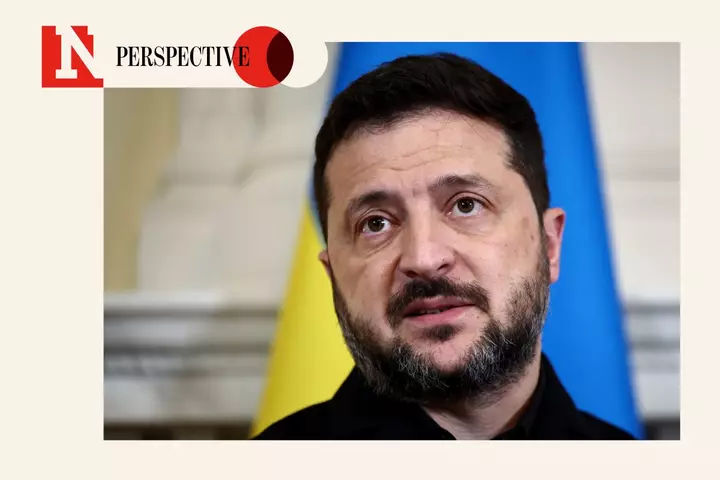
Before the Oval Office meeting of February 2025 blew up on camera, there was a question about clothes. Why, a reporter asked Volodymyr Zelensky, wasn’t he wearing a suit? He would wear "a costume," Ukraine’s president replied, once the war was over.
The war was not over by August when he came back to the White House, but he wore something close enough: black, cut with military lines by a Ukrainian designer. The same reporter told him he looked fabulous. Donald Trump chimed in that he’d said the same.
Zelensky got the last word, noting the reporter was wearing the same suit as before: "I changed, you did not." Fourteen months on, the suit has bought Zelensky nothing. On October 10, a day after announcing a diesel deal with Vladimir Putin, Trump said it was "time for Ukraine to get a new president." He later told Newsmax he finds Zelensky harder to deal with than Putin, and then said someone else should negotiate for Kyiv. The Kremlin said it "fully" agrees.
Zelensky should take them up on it. Not because his critics are right about him, but because they are almost certainly wrong, and his departure is the only experiment that can prove it. Of course, Zelensky can be abrasive.
He can be, to many eyes, ungrateful. He fights in public: he called the diesel deal "a weak decision by our strong partners." He can be defiant of allies, too. Zelensky kept striking Russian refineries despite, by one U.S. official’s count, half a dozen requests to stop.
At home, corruption investigations had worn his standing thin. In Kyiv International Institute of Sociology (KIIS) interviews on October 8 and 9, before the diesel deal, more Ukrainians distrusted him than trusted him, 52 percent to 43 percent. Still, Zelensky has become a prism through which Washington and Moscow refract their frustration with a war that will not end on their terms.
Extract — continue reading at the source.