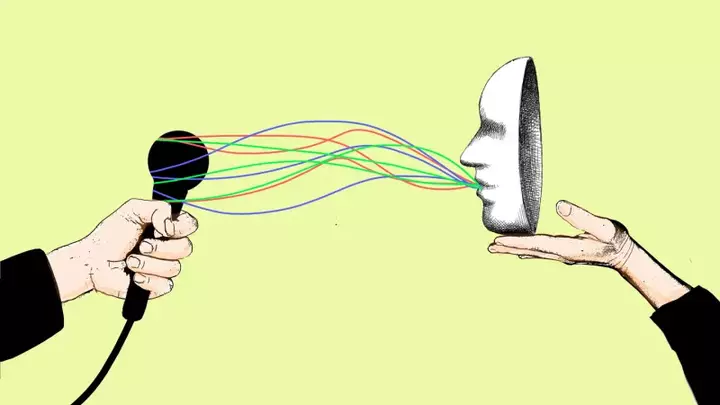
AI technology can create realistic clones of people’s voices. The resulting proliferation of synthetic voices ushers in all sorts of new scenarios, good and bad. Some of these voice clones are deeply meaningful to people, as in the cases of people who lost their ability to speak.
But voice clones can also cause harm, as with scams and deepfakes. And some uses fall into murky gray zones, such as voice clones that “speak” after a person has passed away. What happens to a person’s digital voice after they’re gone?
In this episode of The Deep End: Talk to Me, hear more from Farid, as well as from a former hospital chaplain and AI researcher, and from Jules Rodriguez, a man who communicates with a voice clone. You’ll also hear about a choice Jules made about what will happen to his voice once he’s gone. Laura Sanders: What’s a voice you like to listen to?
Kate Nilson: That is a great question. I hope my students don’t listen to this. I was having Snoop Dogg read their assignments to me the other day, just because I thought it was funny.
But I don’t know if I would say that’s my favorite. Sanders: That’s speech language pathologist and professor Kate Nilson. And if you’re wondering, this is a real, legitimate thing that anyone can do.
Snoop Dogg audio: Vector mathematics. Your displacement from your starting point is a vector. Sanders: Snoop has partnered with a company called Speechify.
Extract — continue reading at the source.