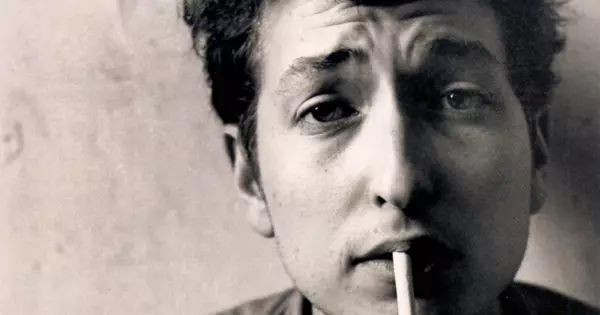
And since poetry, per Muriel Rukeyser’s beautiful definition, is an art that relies on the “moving relation between individual consciousness and the world,” to glimpse Dylan’s poetic prowess is to grasp at once his singular consciousness and our broader experience of the world. That’s precisely what shines through in Paul Zollo’s 1991 interview with Dylan, found in Songwriters On Songwriting (public library) — that excellent and extensive treasure trove that gave us Pete Seeger on originality and also features conversations with such celebrated musicians as Suzanne Vega, Leonard Cohen, k.d. lang, David Byrne, Carole King, and Neil Young, whose insights on songwriting extend to the broader realm of creative work in a multitude of disciplines. Zollo captures Dylan’s singular creative footprint: Pete Seeger said, “All songwriters are links in a chain,” yet there are few artists in this evolutionary arc whose influence is as profound as that of Bob Dylan.
It’s hard to imagine the art of songwriting as we know it without him. There’s an unmistakable elegance in Dylan’s words, an almost biblical beauty that has sustained his songs throughout the years. One essential aspect of Dylan’s creative process that comes up again and again in the interview is the notion of the unconscious and the optimal environment for its free reign.
Dylan tells Zollo: It’s nice to be able to put yourself in an environment where you can completely accept all the unconscious stuff that comes to you from your inner workings of your mind. And block yourself off to where you can control it all, take it down… Like many creators, Dylan values that unconscious aspect of creativity far more than rational deliberation, speaking to the idea that the muse cannot be willed, only welcomed — a testament to the role of unconscious processing in the psychological stages of creative work. He tells Zollo: The best songs to me — my best songs — are songs which were written very quickly.
Yeah, very, very quickly. Just about as much time as it takes to write it down is about as long as it takes to write it. In order to do that, he adds, one must “stay in the unconscious frame of mind to pull it off, which is the state of mind you have to be in anyway.” Contrary to Bukowski’s punchy assertion that the ideal environment for creativity is an irrelevant delusion and E.B.
White’s admonition that “a writer who waits for ideal conditions under which to work will die without putting a word on paper,” Dylan believes this optimal frame of mind can be induced — or, at least, greatly aided — by the right conditions: For me, the environment to write the song is extremely important. The environment has to bring something out in me that wants to be brought out. It’s a contemplative, reflective thing… Environment is very important.
People need peaceful, invigorating environments. Stimulating environments. To foster such unconscious receptivity, Dylan argues that “you have to be able to get the thoughts out of your mind” and explains: First of all, there’s two kinds of thoughts in your mind: there’s good thoughts and evil thoughts.
Extract — continue reading at the source.